
Resources / Guide
Practical guide · Seneca
Signal Booster vs DAS: Small-Area Coverage or a Building-Wide System?
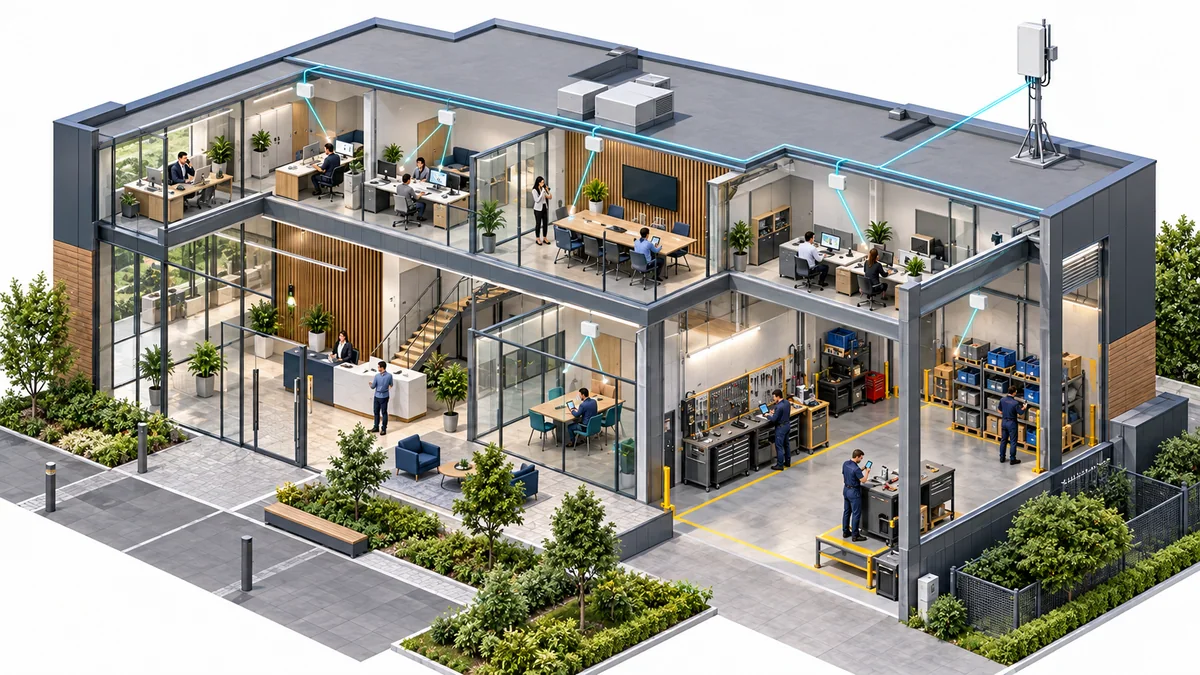
A small office with one mobile dead spot needs a different solution from a hospital, stadium or multi-storey building. A signal booster usually addresses a limited area. A distributed antenna system (DAS) takes coverage throughout the building, with an architecture that can expand across floors, wings and neighbouring buildings.
The next decision is where that indoor signal comes from: an off-air repeater brings the outdoor mobile signal inside, while an operator-connected active DAS uses dedicated signal sources agreed with the mobile network operators. Seneca designs and delivers both, matching the system to your estate and the people who use it.
Signal boosters: a practical fix for a small coverage gap
A typical small booster installation has an outdoor donor aerial, a repeater and a single indoor coverage aerial. The donor aerial receives the operator’s signal outside; the repeater amplifies it and the indoor aerial provides coverage over a local area. Some systems can support additional indoor aerials, but the starting point is a small, defined requirement.
Think of a small office where staff step outside to make calls, or a shop where reception disappears behind the counter. With suitable outdoor signal, a correctly specified booster can restore mobile service where it is needed without installing a building-wide distribution system. The benefit is straightforward: fewer interruptions, usable mobile apps and people staying where the work happens.
DAS: comprehensive coverage designed around the building
A distributed antenna system puts coverage points throughout the areas that need service. Instead of expecting one aerial to reach through every wall and floor, the design distributes the signal to the right locations.
In a scalable powered system, central or head-end equipment connects to distribution and remote coverage units over suitable cabling, with indoor aerials or integrated radios serving individual areas. Additional units extend the design across floors, wings or an estate. Simpler passive DAS designs use coaxial cable, splitters and distributed aerials without powered remote units.
For a hotel, that means designing coverage around bedrooms, meeting rooms, reception and service areas. For a warehouse, it means reaching offices, loading bays and working aisles. The gain is a planned coverage solution for the building, rather than a collection of isolated fixes.
Off-air repeater DAS: bring the outdoor network indoors
An off-air repeater DAS starts with the mobile signal already available outside. Donor aerials receive the required operator signals, repeaters feed them into the system, and the DAS distributes them to coverage points inside the building.
This combines the signal source used by a booster with the reach of a distributed installation. It can serve multiple floors and larger premises, and can support multiple operators when the equipment and design provide for them. Powered network and coverage units can make the distribution scalable; the signal source is still off-air.
It is a strong option where the outdoor networks provide a suitable signal and the building is preventing that service from reaching its users. Staff, guests and visitors continue using their normal mobile phones and subscriptions. The system extends access to the outdoor network’s capacity; it does not create a new allocation of mobile network capacity for the building.
Operator-connected active DAS: engineer coverage and capacity together
Where the estate needs dedicated indoor capacity, or outdoor donor coverage cannot meet the requirement, an operator-connected active DAS provides a different foundation. Dedicated operator-approved signal sources feed a central system, which distributes the service to powered remote radio units and aerials throughout the site.
These projects are delivered in conjunction with the participating mobile network operators, to their technical, integration and acceptance requirements. The design brings together the operators to be supported, the required coverage, expected traffic, cabling, equipment locations and ongoing operation. Capacity comes from the agreed radio sources and network provision, not simply from adding more aerials.
For a stadium, hospital or large commercial development, this creates a route to indoor mobile infrastructure planned around the site’s demand. It shares engineering characteristics with private 5G, including radio planning and powered equipment distributed around the estate. The purpose is different: public-operator DAS serves the participating mobile networks and their subscribers, while private 5G serves a separately designed private network.
Three approaches, clearly compared
| Approach | Signal source | Coverage design | Typical requirement |
|---|---|---|---|
| Small signal booster | Outdoor mobile signal | Typically one indoor coverage aerial for a limited area | A small office, shop or local dead spot |
| Off-air repeater DAS | Outdoor mobile signal, received through donor aerials and repeaters | Distributed aerials or coverage units across the building | Wider indoor coverage where suitable outdoor service exists |
| Operator-connected active DAS | Dedicated operator-approved signal sources | Central equipment and powered remote units designed across the estate | Large or demanding sites needing coverage and capacity planned together |
Off-air describes the signal source; active describes powered distribution. An off-air system can therefore use active equipment. The useful distinction when choosing a solution is both how the signal is supplied and how it reaches users.
What determines the cost?
A small booster is a limited installation. A distributed system adds coverage units, aerials, cabling and commissioning across the estate. An operator-connected active DAS also includes the agreed signal sources, operator integration and associated project work.
Floor area is only part of the picture. Building construction, cable routes, the operators required and busy-period demand all affect the design. Seneca will assess your estate, identify the appropriate approach and help build the business case, with a clear scope and quotation. We can address a priority area first or deliver the complete installation as one project.
Get coverage that fits your business
Tell us where mobile service is letting you down. We will assess the outdoor signal and indoor requirement, explain the options and take responsibility for the survey, design, installation and commissioning of the agreed solution.
Talk to Seneca about indoor mobile coverage, or explore mobile coverage equipment in the Shop.
Frequently asked questions
Can a signal booster cover more than one room?
Yes. The area depends on the equipment, aerial arrangement and building. A single indoor aerial can serve a local area containing several rooms; a wider requirement may call for a distributed design.
Does DAS automatically mean every mobile operator?
No. The supported operators are part of the specification. Both the signal sources and the distribution equipment must support the networks included in the project.
Does an active DAS always connect directly to an operator?
No. Active refers to powered equipment in the distribution system. It can be fed off-air or from operator-approved sources. An operator-connected active DAS is the dedicated-source option described above.
Is an active DAS the same as private 5G?
No. They share radio engineering principles, but an operator-connected DAS extends participating public mobile services inside the estate. A private 5G network provides separately configured connectivity for the organisation’s devices and applications.