Building and access
Floor area, walls, racking, cable routes and access restrictions determine equipment placement and installation work.

Mobile coverage / Across the UK
Missed calls cost time. Dead spots interrupt work and frustrate customers. Seneca brings EE, O2, Vodafone and Three into the places your people need them—with one partner for design, installation and ongoing support.
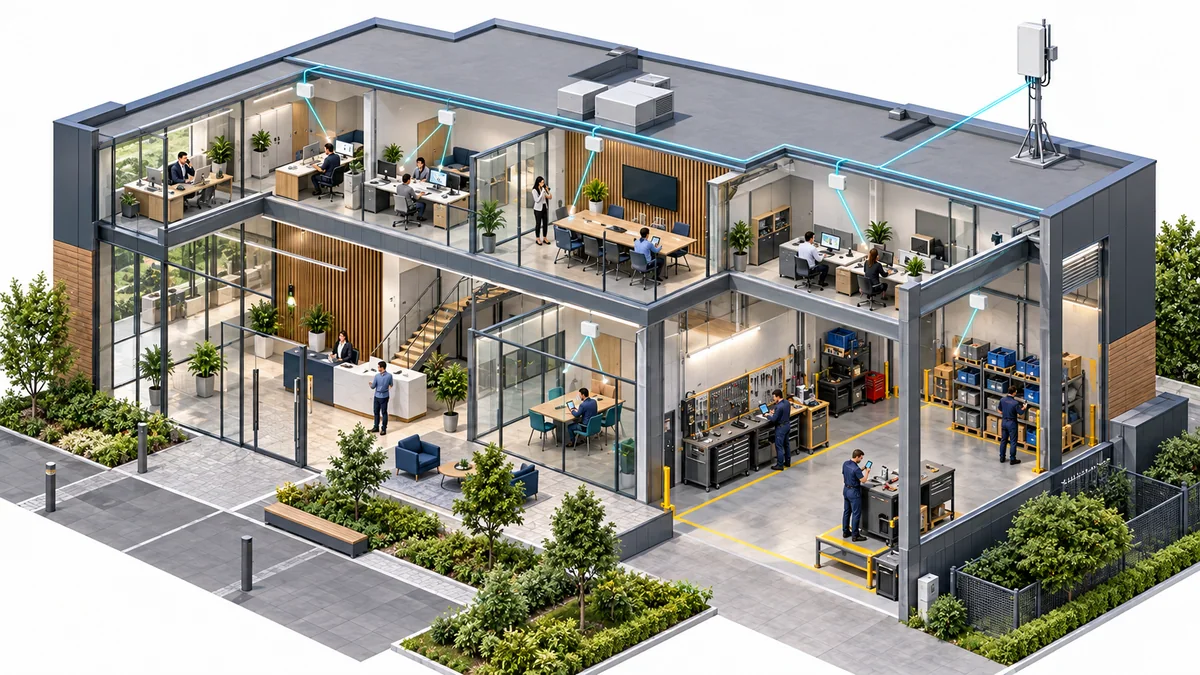
One building. Connected people.
A distributed antenna system (DAS) carries mobile service from a signal source to antennas positioned throughout a building. It brings calls, messages and mobile data into areas that outdoor coverage cannot reliably reach.
Staff stay at their desks to take calls. Customers can open a loyalty voucher at the till. Hospital estates teams can reach a contractor in the room where the work is happening.
We design around the areas that matter: meeting rooms, guest rooms, stockrooms, corridors and basements. People keep using their existing phones and SIMs.
Why mobile signal fails indoors →The distribution design determines how coverage reaches each part of the building. Passive, active and hybrid systems serve different layouts, cable distances and expansion requirements.
| Architecture | How coverage is distributed | Where it fits |
|---|---|---|
| Passive | Coaxial cable, splitters and antennas distribute the radio signal. Cable losses shape the design. | Shorter cable routes and relatively compact coverage areas. |
| Active | Powered distribution and remote units carry the signal across longer routes, often over fibre. | Larger buildings, multiple floors and sites requiring scalable distribution. |
| Hybrid | An active backbone feeds local passive antenna branches. | Sites with a mix of long backbone routes and compact coverage zones. |
An external antenna receives the outdoor mobile signal. A compliant repeater feeds it into the indoor distribution system. This makes usable outdoor coverage available inside.
An agreed mobile-operator source feeds the system, with the distribution and powered radios designed to the relevant requirements. Seneca coordinates the operator arrangements and installation programme. This is the route to assess when off-air reception or available capacity cannot meet the requirement.
Active distribution does not, by itself, tell you whether the signal comes from a repeater or an operator connection. We specify both in the proposal.
A compact booster suits a small coverage requirement with usable outdoor signal. A DAS provides an engineered distribution system for broader coverage across a building or estate.
A booster is often installed with a single indoor antenna for a small area. As the requirement grows, central equipment, distribution units and additional antennas provide the reach and scale. A repeater and a DAS can work together: the repeater supplies the signal; the DAS distributes it.
Compare signal boosters and DAS →Build the business case
Compare indicative installed costs for buildings from 0–5,000 m², based on the layout and construction.
| Building model | 0–5,000 m² · Installed cost, ex VAT |
|---|---|
| Open space with medium/high ceilings | £2,000–£37,000 |
| Open-plan office | £2,000–£42,000 |
| Mixed layout—open areas, walls and obstacles | £2,000–£54,500 |
| Dense walls—brick or concrete | £2,000–£66,000 |
Ranges include equipment, antennas, cabling, survey, design, installation, commissioning and one-year support. Indicative; confirmed by survey; ex VAT. Excludes travel & accommodation and the optional hardware-replacement service.
Floor area, walls, racking, cable routes and access restrictions determine equipment placement and installation work.
The number of networks, radio technologies and choice of signal source shape the system. Coverage and busy-period capacity are separate requirements.
Choose the support term and hardware replacement arrangements around the service your business needs.
Mobile coverage in your world
Keep the customer connected to the sale.
Explore mobile coverage →Make a good stay easier to repeat.
Explore mobile coverage →Get clear information to the people who need it.
Explore mobile coverage →Keep the station connected to the working day.
Explore mobile coverage →Give time back to the people who care.
Explore mobile coverage →Keep indoor hospitality and facilities teams connected.
Explore mobile coverage →Bring the shore connection on board.
Explore mobile coverage →Close the delivery while the details are fresh.
Explore mobile coverage →Keep engineers connected on the floor.
Explore mobile coverage →Keep goods and information moving together.
Explore mobile coverage →Reach the people beside the machine.
Explore mobile coverage →Connect the people running your campus.
Explore mobile coverage →Keep business calls inside the building.
Explore mobile coverage →Keep public services within reach.
Explore mobile coverage →Keep residents in touch and staff within reach.
Explore mobile coverage →A shared, multi-operator system brings the selected mobile networks into the building through coordinated infrastructure. Tenants and visitors can use their own network without separate installations for every occupier.
Seneca supports EE, O2, Vodafone and Three. We agree the required networks and service areas, coordinate the signal sources and provide one accountable partner for delivery and ongoing management.
For landlords and multi-tenant estates, that means a building-wide approach to coverage, with clear responsibilities for access, maintenance and future changes.
One accountable partner
Seneca handles the survey, design, installation, commissioning and ongoing support. Survey to live is typically around one week, depending on the project; larger and operator-connected deployments follow an agreed programme.
We measure reception, review the estate and separate coverage problems from capacity problems. We help build the business case around the areas and users that need improvement.
We coordinate equipment, cabling and access around your operation. Calls, data and coverage are checked in the agreed areas against the acceptance criteria.
Local support and an agreed maintenance arrangement give your team a clear point of responsibility after handover.
Start with the spaces causing problems or commission the wider estate. We plan delivery around your priorities and readiness.
Static indoor repeaters are licence-exempt when they meet Ofcom’s technical conditions. A seller’s claim of approval is not a substitute for compliance.
Compliant static indoor repeaters can serve more than one operator. Equipment outside the exemption needs the appropriate authorisation; non-compliant repeaters must not be installed as licence-exempt devices.
Ofcom repeater guidance ↗We design and install distributed antenna systems to the Joint Operators Technical Specification (JOTS DAS), which sets requirements for third-party in-building DAS. Operator connection and acceptance arrangements are agreed for the project.
JOTS technical specifications ↗Start with the service your people need and the spaces where reception fails. These answers explain the main buying decisions.
For buildings from 0–5,000 m², indicative installed costs are £2,000–£37,000 for open space with medium/high ceilings, £2,000–£42,000 for open-plan offices, £2,000–£54,500 for mixed layouts and £2,000–£66,000 for dense brick or concrete walls. All prices exclude VAT and include equipment, survey, design, installation, commissioning and one-year support. Final costs are confirmed by survey; travel, accommodation and optional hardware replacement are excluded.
A compact booster can cover a small area when a suitable outdoor signal is available. A DAS distributes coverage across a larger building, several floors or more complex spaces. An off-air repeater can feed a DAS; an operator-connected system uses an agreed operator signal source.
Static indoor repeaters can be used without an individual licence when they meet Ofcom’s licence-exemption requirements. Devices that do not meet those requirements are not covered by that exemption. Operator-connected systems require the appropriate operator and regulatory arrangements.
Seneca’s indicative timescale is typically around one week from survey to live, depending on the project. Larger installations, access restrictions and operator-connected deployments need an agreed programme.
Yes. Seneca designs solutions for EE, O2, Vodafone and Three. The proposal identifies the networks, technologies and coverage areas included.
DAS distributes public mobile service for people using their existing phones and SIMs. Private 5G provides a dedicated network for your organisation’s devices and applications. A small cell is a radio base station that can provide a local mobile signal source; it is not the same thing as the distribution system. A site can use both DAS and private 5G.
We test coverage, calls and mobile data in the agreed areas against the acceptance criteria, then hand over the system with clear support responsibilities.
Seneca Enterprise · Across the UK
Tell us where calls drop and work slows down. We’ll assess the estate, explain the options and help you build the business case.