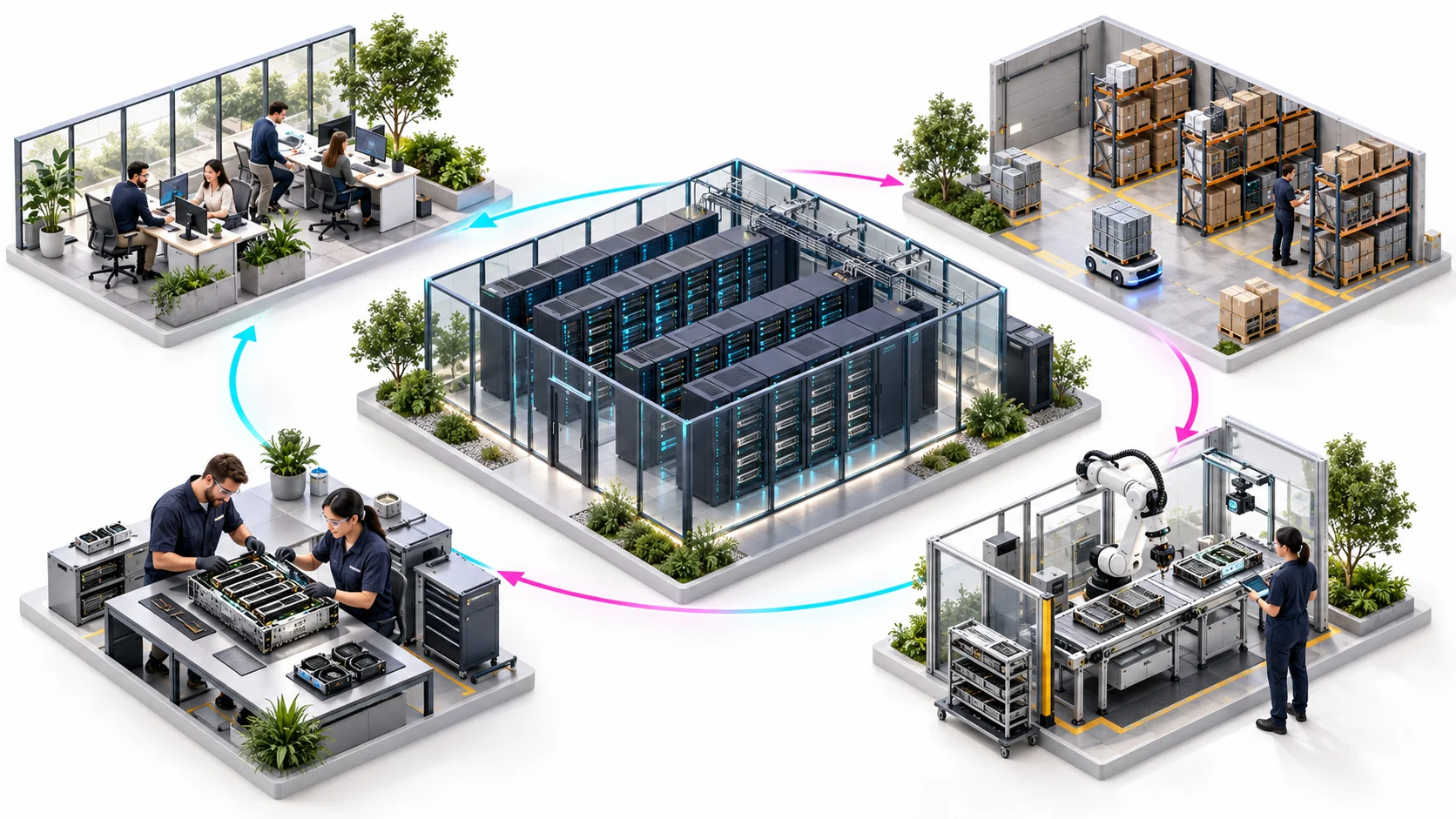
These illustrative use cases show where dedicated GPU infrastructure can support your operation.
Give your team a private knowledge assistant
An engineering team loses time searching manuals, service records and project files. A private assistant retrieves relevant material and prepares an answer with links back to the source, using permissions aligned with the team’s access.
Seneca brings the model, document search and GPU environment together. Staff get a quicker route to useful information, while the organisation controls where the system runs and which documents it can use.
The gain: less time searching, reusable organisational knowledge and a clear boundary around sensitive information.
Move documents through the business faster
Invoices, delivery notes and technical reports arrive in different formats. GPU-assisted document models extract information, identify document types and prepare structured records for the people and applications that need them.
Connect the results to your business workflow, with exceptions sent to the right team for review. A shared processing environment can serve several departments instead of each building a separate collection of tools.
The gain: less rekeying, shorter processing queues and more consistent records.
Give cameras and robotics intelligence close to the operation
A production camera captures an item as it passes an inspection point. A locally deployed vision model analyses the image and raises a quality exception for the operator, with evidence attached to the job.
The same infrastructure can support image analysis and perception workloads used by warehouse robotics. Seneca connects the compute to the relevant applications and networks, keeping safety-critical machine controls within their engineered control systems.
The gain: earlier visibility of defects, less manual image review and operational data processed close to where it is created.
Adapt models to your business
A specialist team needs an AI model to recognise its terminology or produce a consistent output format. Fine-tuning adjusts a suitable existing model using selected examples; evaluation checks the result against the tasks the team actually performs.
Dedicated GPU capacity gives developers a controlled place to experiment, compare versions and run the resulting service. Training larger models requires a different scale of investment, which we scope around the intended workload.
The gain: more relevant AI behaviour and a repeatable path from development to a working service.
Keep research and analytics moving
Researchers and analysts can wait for shared resources while datasets continue to grow. GPU-enabled software accelerates supported simulations, numerical calculations and data-processing tasks, giving the team dedicated capacity for demanding work.
Seneca sources a platform around the software and data involved. We include storage throughput, memory and scheduling in the design so that the processors are fed with useful work.
The gain: greater control over research schedules and the capacity allocated to priority projects.