
Home / Private 5G / Private 4G vs private 5G: bandwidth, slicing and advanced capabilities
Practical guide · Seneca
Private 4G vs private 5G: bandwidth, slicing and advanced capabilities
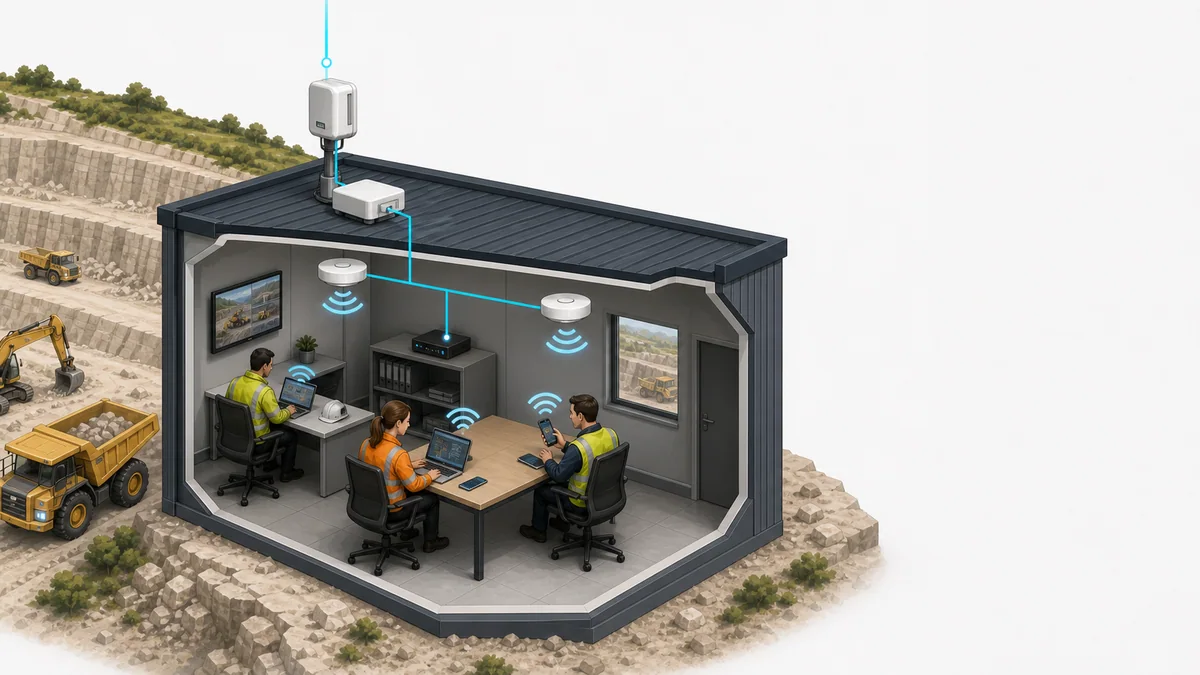
Private 4G LTE connects people, machines and operational applications with a mature device ecosystem. Private 5G adds wider radio channels, more flexible scheduling and a service architecture built for differentiated workloads. For businesses adding video inspection, robotics and edge AI, those differences create room to do more on the same network. Seneca designs and manages private 5G networks across the UK.
Private 4G vs private 5G at a glance
| Capability | Private 4G LTE | Private 5G standalone | Why it matters |
|---|---|---|---|
| Channel bandwidth | Up to 20 MHz per component carrier. | Up to 100 MHz per carrier in relevant FR1 mid-band configurations. | A wider channel provides more radio resources for concurrent traffic. |
| Carrier aggregation | LTE-Advanced combines component carriers to exceed 20 MHz overall. | NR also supports carrier aggregation across supported combinations. | Compare usable spectrum and device support, alongside single-carrier width. |
| MIMO and beamforming | Supports multiple antenna paths, beamforming and advanced antenna systems. | Extends beam management and spatial multiplexing, including massive MIMO on suitable radios. | Improve capacity and direct radio energy towards devices. |
| Service differentiation | Bearer-based quality of service, traffic priorities and separate access-point names. | QoS flows and native 5G Core network slicing. | Give different workloads defined service policies within one infrastructure. |
| Timing | Established LTE scheduling and industrial connectivity capabilities. | Flexible numerology, shorter scheduling opportunities and URLLC enhancements. | Design for faster responses and demanding industrial traffic. |
| Industrial integration | Local applications and industrial gateways are well established. | Standards include Ethernet services and integration with time-sensitive networking. | Extend the options for connecting industrial applications wirelessly. |
| Local operation | A private core and local applications can keep traffic on site. | A local 5G Core user-plane function can route traffic directly to edge applications. | Both can support private data handling and reduced external dependence. |
4G vs 5G channel widths: 20 MHz and 100 MHz
A radio channel is the slice of spectrum carrying the connection. LTE supports up to 20 MHz in a single component carrier. In relevant mid-band 5G NR deployments, a single carrier can span 100 MHz. That is five times the channel width, giving the network more frequency resources to schedule traffic across.
LTE · 20 MHz
5G NR · 100 MHz
Illustrative single-carrier comparison. Channel width is spectrum capacity, not a fivefold application-speed guarantee.
In a warehouse, that extra capacity can serve camera feeds, robot telemetry and handheld transactions together. In a factory, it provides room for inspection images and machine data as the connected estate grows. Delivered throughput also depends on the uplink/downlink allocation, signal quality, modulation, antenna layers and devices using the channel.
Carrier aggregation changes the comparison. LTE-Advanced can join several carriers: five 20 MHz carriers provide 100 MHz of aggregate bandwidth. 5G supports aggregation too. The advantage is that 5G can provide that 100 MHz within one supported mid-band carrier; the correct comparison includes the spectrum, radios and devices available to your site. Other 5G bands and configurations use different widths, including wider channels at millimetre-wave frequencies.
Private 5G network slicing and service separation
A port's cameras, maintenance team and operational vehicles have different connectivity needs. A 5G network slice is a logical network with its own service characteristics, built on shared infrastructure. With a supporting standalone 5G Core, the design can separate service groups and apply different policies to their traffic.
For example, an operational device group can have defined service priorities while a video workload uses a separate slice. Seneca designs the radio scheduling, transport and core policies together so the intended separation has meaning across the connection. Capacity comes from the underlying network; slicing organises how that capacity serves the operation.
LTE already supports traffic prioritisation through quality-of-service bearers and separate APNs. 5G adds native slice selection and a more flexible QoS-flow model. A slicing deployment needs support in the chosen core, radio software and devices; we include the required configuration in the proposal.
4G vs 5G massive MIMO and beamforming
MIMO means multiple input, multiple output: multiple antenna paths carry information through the radio link. Beamforming steers radio energy towards devices. Massive MIMO uses larger antenna arrays and many radio chains to form beams and, where conditions support it, serve multiple devices on the same time and frequency resources.
That makes it valuable in busy yards, terminals and outdoor operating areas with many active devices. A suitable array can improve spatial reuse and coverage, giving the network more ways to serve the people and equipment within its footprint.
These techniques also exist in advanced LTE. 5G develops them further through its beam-centric radio design. A compact 2T2R or 4T4R private small cell is a different proposition from a larger 32T32R or 64T64R massive-MIMO radio. Seneca selects the antenna system around your site and capacity needs, rather than treating every 5G radio as the same product.
4G vs 5G latency and industrial timing
5G NR supports flexible subcarrier spacing and shorter scheduling opportunities, giving a network designer more control over how quickly traffic is transmitted. Ultra-reliable low-latency communication, or URLLC, adds capabilities for demanding industrial communications. These are useful when an application needs timely delivery as well as capacity.
The practical question is how quickly the complete workflow responds. A camera sends an image, the radio carries it, the core routes it and edge AI processes it before a result reaches the operator. Hosting the application locally removes an external journey from that path. We size and configure the whole service for its response-time, reliability and load requirements; a generic “1 ms” radio headline does not describe that complete journey.
5G industrial standards also include Ethernet transport and integration with time-sensitive networking (TSN), helping supported deployments fit into coordinated industrial networks. We identify the release, software and device support needed for these capabilities as part of the design.
Private 4G vs 5G uplink capacity for cameras
Many industrial applications send more information towards the network than they receive. Inspection cameras upload images, robot dogs send video and sensor readings, and vehicles report their position and job status. A strong download-speed figure tells only part of that story.
In time-division duplex, or TDD, uplink and downlink share a frequency channel at different times. The frame pattern determines how much transmission time each direction receives. We design around your traffic mix, spectrum coordination and device uplink capabilities so that a wide channel supports the work you actually want to carry.
Private 4G and 5G for factory inspection and robotics
A factory already uses private LTE for handheld transactions and machine telemetry. Those workloads fit its capacity, and the devices are supported. The next phase introduces mobile inspection robots and multiple cameras sending images to local AI. The requirement has changed from occasional updates to sustained uplink traffic alongside existing operational tasks.
A private 5G design can combine a wider channel, an uplink allocation suited to the camera streams and a local application path. QoS policies keep robot status and job messages distinct from bulk image transfers; slicing can extend that separation where the selected system supports it. The gain is more inspection coverage and useful operational information without making people collect every observation manually.
Choosing private 4G or 5G for a UK business
Private LTE remains a strong option where supported devices, coverage and moderate traffic meet the operation's needs. Existing scanners, gateways and telemetry systems can retain their value. Both private LTE and private 5G can provide SIM-based access, local data routing and infrastructure under your control.
Private 5G is the stronger starting point for growing, mixed industrial workloads that benefit from wider channels, richer service differentiation and advanced radio capabilities. Confirm 5G standalone support, the relevant frequency band and channel width across the radio and device fleet. Features such as slicing and TSN should be specified as part of the delivered service.
Plan your UK private 4G or 5G deployment
Tell us what you want to connect and where the current operation falls short. Seneca assesses spectrum availability, devices, traffic and the application environment, then explains the design, deployment and support costs. For UK sites, the usable channel width comes from the spectrum available and licensed at your location.
Start with a focused deployment or move ahead with a wider programme. We connect the radio, core, private compute and applications around the outcome your business needs.
Private 4G vs 5G questions
Does a 100 MHz 5G channel guarantee faster applications?
No. Channel width is one part of the design. Available spectrum, radio and device support, signal conditions, uplink demand and the application path determine the delivered result.
Does every private 5G network include network slicing?
No. Slicing depends on the selected core, radios, device support and service design. It must be specified and tested; the 5G label alone does not establish availability.
How much does private 4G or 5G cost to deploy?
Price the required coverage, devices, core, installation and ongoing support together. Use the private 5G cost guide and calculator for a starting estimate, then compare proposals against the same operational requirements.