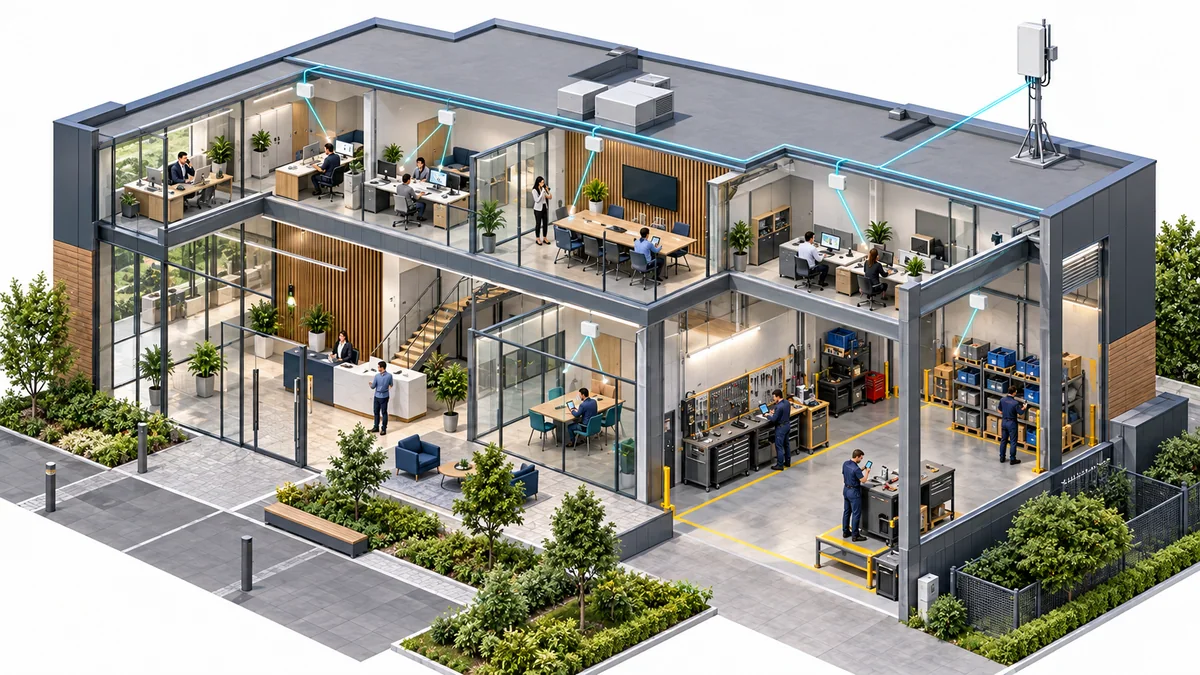
No Mobile Signal Inside Your Building? Why It Happens and How to Fix It
The short answer
Modern building materials — steel frames, foil-backed insulation and metal-coated glass — block mobile signal. To fix it: confirm the problem with an indoor signal survey, then choose between Wi-Fi calling, an Ofcom-compliant smart signal booster (from £639.60), or a multi-operator DAS for larger buildings. Costs run from nothing to tens of thousands of pounds.
If your staff walk out to the car park to take calls, you have an in-building coverage problem — and it is almost certainly the building’s fault, not the network’s. This is one of the most common faults we get called out to, it is measurable, and every fix sits on a well-understood ladder from free to fully engineered. This page explains why it happens, how to prove it, what the options genuinely cost, and who does what.
Why modern buildings kill mobile signal
Mobile signal is radio, and radio hates modern construction. A steel-framed building with metal cladding behaves like a partial Faraday cage: the frame and skin reflect and absorb the signal before it reaches anyone inside. That is why coverage in a warehouse or factory often collapses within a few metres of the roller door even when the mast is visible from the yard.
New offices are frequently worse than old ones. Building regulations push energy efficiency, and the materials that deliver it are exactly the ones that block radio: low-emissivity (low-E) glass carries a microscopic metallic coating that reflects heat — and mobile signal — extremely effectively; foil-backed plasterboard and insulation line the walls with a continuous metal layer; and dense reinforced concrete attenuates what little gets through. A building that scores well on energy performance is, from a radio point of view, a well-sealed box. This is why the question we hear most — “why is there no signal in our brand-new office?” — has such a consistent answer: the better the fabric, the worse the coverage.
Basements are the extreme case. Below ground there is no direct path from any mast, so a basement office or plant room typically has no usable signal from any operator at all. Older council and civic buildings suffer a different version of the same problem: metre-thick masonry, and retrofitted double glazing with the same metallic coatings.
One more factor: the outdoor network is not uniform. Your building may sit in a spot where one operator is strong and another is weak, so the problem often only affects staff on particular networks — which is a clue worth capturing properly.
Step one: prove it with an indoor signal survey
Before spending anything, measure. An indoor mobile signal survey walks the building with calibrated equipment and records signal strength and quality (RSRP/SINR) for each mobile operator, floor by floor, onto your floor plans. The output is a set of heat maps showing exactly where coverage fails, on which networks, and how badly — which turns “the signal is rubbish” into an engineering specification. It also stops you buying the wrong fix: a booster needs a usable donor signal somewhere on the building (usually the roof), and only a survey tells you whether one exists and which operator provides it.
If you are planning a fit-out or a move, test before you commit. Survey the shell after the glazing and cladding are in — coated glass changes the radio environment completely, so a bare-concrete-frame reading taken earlier is misleading. Ten minutes of measurement per floor at that stage is far cheaper than discovering on day one of occupation that nobody can make a call.
Seneca carries out indoor coverage surveys across the UK as a standalone service — you get the report and can act on it with any supplier. Details are on our services page at https://senecaenterprise.com/services/.
The fix ladder: your options, honestly compared
There are four rungs, and you should start at the bottom. First, the free fixes: enable Wi-Fi calling on staff phones and check it is allowed on your corporate Wi-Fi. If your Wi-Fi is solid, this alone solves calling for many offices. Its limits are real, though: it does nothing for visitors and contractors, nothing on the warehouse floor if the Wi-Fi is patchy there too, and calls can drop when a phone hands between Wi-Fi and mobile at the door.
Second, operator femtocells — small boxes that create a mini mobile cell over your broadband. These were a good answer a decade ago, but UK operators have largely withdrawn their consumer femtocell products, and the business-grade equivalents are supplied at the operator’s discretion via your account team, serve a single operator, and have become rare since the consumer ranges were withdrawn. We rarely recommend chasing this route today.
Third, an Ofcom-compliant smart repeater (commonly called a signal booster). These take usable signal from your roof, amplify it intelligently, and rebroadcast it indoors — and they come in single-operator and multi-operator forms, supporting both 4G/LTE and 5G. A single-network unit like the Nextivity GO covers one operator’s network; multi-operator systems such as the Cel-Fi QUATRA family rebroadcast several operators at once across a building. What the law cares about is the equipment: compliant smart repeaters that protect the operators’ networks are legal to use, while the cheap wideband amplifiers sold on marketplace sites are not — they interfere with the networks, and Ofcom can and does act on that. The honest limitations of any repeater are threefold: you need a usable donor signal to amplify; a repeater redistributes the operator’s existing cell rather than adding capacity, so a busy site shares whatever that cell can give; and your indoor experience inherits the performance of the operator’s cell — if it is congested or degraded outside, it will be indoors too. Those three boundaries are exactly where an engineered DAS with its own signal sources earns its money.
A distributed antenna system (DAS) is about more than coverage: it is engineered for capacity and guaranteed performance. A designed network of antennas on dedicated cabling delivers specified signal levels in every area, with the capacity planned for your device count — so it is the answer when a building needs every UK mobile network working everywhere, high user or device density handled without degradation, and performance you can measure at acceptance and hold the system to. The engineering itself is well understood — at scale the cost gap between a large multi-operator repeater project and a DAS narrows — and the biggest practical difference is the operator coordination. The real difference is the operators: taking signal from their own equipment brings agreements, coordination (increasingly via the industry’s JOTS neutral-host framework) and their timescales — which is why a typical full DAS project runs around nine months or more end to end, where repeater-based systems go in over days to weeks. It is the right spend for large warehouses, hospitals, multi-tenant offices and basements. Our detailed comparison is at https://senecaenterprise.com/signal-booster-vs-das/.
| Option | Best for | Operators covered | Honest limitation |
|---|---|---|---|
| Wi-Fi calling | Offices with good Wi-Fi | All (via handset) | No help for visitors or Wi-Fi dead zones |
| Operator femtocell | Legacy single-operator sites | One | Largely withdrawn by UK operators |
| Smart repeater system | Small to large buildings with usable roof signal | Single- or multi-operator, 4G & 5G | Needs a usable donor signal; capacity and performance are the operator cell’s |
| Multi-operator DAS | Large or high-density buildings; guaranteed performance | All UK networks | Engineered project — design and operator lead times |
What it actually costs
The cost story is a ladder, and each rung’s price is the price of what you are adding. The bottom rung is free — Wi-Fi calling costs nothing to try. The next rung is hardware in a box: our current Nextivity range runs from £639.60 to £1,123.20 including VAT at the shop. The rungs above buy engineering — survey, design, professional installation and commissioning: engineered coverage runs around £3–£7 per square metre installed for legal, good-quality repeater systems (fewer networks and larger buildings sit at the lower end — a 10,000 m² warehouse lands at around £30,000 for two-operator coverage, with more networks pushing towards £51,000; buildings under about 5,000 m² are priced per project because survey, design and head-end costs are fixed). The top rung, a carrier-grade DAS, adds the operators themselves — and it is their coordination, not the engineering, that sets the timescale. Every real building is priced from a survey.
And because size and monthly cost decide most budgets: on indicative 60-month finance (8% flat, subject to status), a £30,000 two-operator warehouse system is around £540 a month, and a £51,000 all-networks system around £918 a month. Ask for a finance quote alongside any system quote.
| The rung | What you’re buying | Typical setting | Cost guide |
|---|---|---|---|
| Wi-Fi calling | Nothing — a setting on staff phones | Any office with decent Wi-Fi | Free |
| Smart booster | Hardware only: ROAM R41, CONNECT C41 or GO G41 | Vehicles, homes and small premises with usable outdoor signal | £639.60–£1,123.20 inc VAT |
| Engineered system — single or multi-operator | Survey, design, installation and commissioning | Warehouses and larger buildings from roughly 5,000 m² | ≈ £3–£7 per m² ex VAT — smaller buildings priced per project |
| Carrier-grade DAS | Operator-fed signal sources, full design and operator coordination | Large or high-density buildings needing guaranteed capacity | £50,000+ — priced per project; typically 9+ months end to end |
Who does what — and how to choose an installer
A common misconception is that your mobile operator will fix this for you. Operators are responsible for the outdoor network; they will almost never fund or install in-building coverage for a single business tenant. Fixing coverage inside your own building is your project, delivered by a specialist in-building coverage supplier — the trade that search results file under “DAS installers” or “mobile signal booster installers”.
When you compare suppliers, ask four things. Do they survey first, or quote from a postcode? (Anyone quoting without measurements is guessing with your money.) Is every product they propose Ofcom-compliant — and will they say so in writing? Can they do genuine RF design, not just run cable — for a DAS, ask who does the design and how they handle operator coordination. And will they hand over as-built documentation and post-install survey results proving the coverage they sold you?
Seneca Enterprise does this work UK-wide: indoor signal surveys, Ofcom-compliant smart booster design and installation using the Nextivity Cel-Fi range, and multi-operator DAS design for larger buildings — alongside the private 5G, Wi-Fi and IoT connectivity work on the rest of this site. We sell the compliant booster hardware directly at https://shop.senecaenterprise.com/collections/cel-fi, and we will tell you plainly when the free fix is the right fix.
Next step: get the problem measured
Whatever route you end up taking, it starts with a survey — it is the only way to know which operators fail where, whether a booster is even viable, and what a fix should cost. Tell us about your building at https://senecaenterprise.com/get-a-quote/ and we will come back with a survey slot and an honest view of which rung of the ladder you are likely to need. If you just want the background first, start with the booster-vs-DAS comparison at https://senecaenterprise.com/signal-booster-vs-das/.
Frequently asked questions
Why is there no signal in our new office building?
Because the materials that make a building energy-efficient also block radio. Low-E coated glass has a metallic film that reflects mobile signal, foil-backed insulation lines the walls with metal, and steel framing does the rest. New, well-sealed buildings are routinely worse for mobile coverage than the draughty ones they replace. The fix is external: bring the signal in via a compliant booster or DAS, or route calls over Wi-Fi.
What can we do about no phone signal in a basement office?
Below ground there is usually no signal from any operator, so repositioning desks or changing network will not help. Wi-Fi calling is the quick fix if the basement has good Wi-Fi. For a proper fix, a smart booster with its donor antenna on the roof, or a DAS antenna run into the basement, brings real mobile coverage down there. A survey confirms which is viable for your building.
How do we test mobile coverage inside a building before fit-out?
Commission an indoor signal survey once the glazing and cladding are installed — coated glass transforms the radio environment, so earlier readings mislead. The survey measures every operator floor by floor and produces heat maps you can attach to the fit-out specification. If coverage fails, you can then price a booster or DAS into the project while ceilings are still open, which is far cheaper than retrofitting.
How do we improve mobile signal in a large warehouse or factory?
Steel cladding and racking make warehouses the hardest case, and the answer depends on scale. For smaller units with usable signal outside, an Ofcom-compliant smart booster system works well. For large sites, or where all four networks must work across the floor, a multi-operator system or DAS is the right tool. Start with a survey — in metal buildings the difference between “weak” and “nothing” decides the whole design.
Who installs DAS in the UK — do we go to the mobile operators?
No — operators run the outdoor network and very rarely fund in-building systems for individual businesses. DAS and booster systems are designed and installed by specialist in-building coverage companies, who coordinate with the operators where the design needs their signal sources. Choose an installer who surveys before quoting, uses only Ofcom-compliant equipment, and proves the result with a post-installation survey.
Are mobile signal boosters legal in the UK?
Some are. Compliant smart repeaters — available in single-operator and multi-operator versions, covering 4G and 5G — are legal to use in the UK; the Nextivity Cel-Fi range is designed to meet Ofcom’s requirements and protect the operators’ networks. The cheap wideband boosters sold online do not, and using one is illegal. Multi-operator and DAS-grade systems are installed with the appropriate arrangements as part of the project.
Book an indoor signal survey and get an honest, costed fix for your building — start at https://senecaenterprise.com/get-a-quote/
Ready when you are