How Much Does a Private 5G Network Cost in the UK? Real Numbers, Not “It Depends”

How Much Does a Private 5G Network Cost in the UK? Real Numbers, Not “It Depends”

The short answer

A ready-to-deploy private 5G starter bundle costs £9,562 to £39,812 inc VAT — from around £172 a month on 60-month finance. Engineered, installed warehouse networks work out at roughly £4–£10 per square metre from 5,000 sq m upwards (ex VAT), falling as buildings grow. Ofcom spectrum starts at £80 per year per licence (the fee scales with bandwidth).

Ask a private 5G vendor what a network costs and you usually get the same answer: “it depends — talk to sales.” It does depend, but not so much that the numbers can’t be published. We design, build and operate private 5G networks in the UK, we sell ready-to-deploy bundles with prices on the page, and we price installed systems from a published price book. So here are the real figures: what a starter network costs today, what a fully engineered warehouse deployment costs at four floor areas, what moves the price in each direction, and what it costs to run. Where a number genuinely does depend on your site, we say so and explain why.

The short version: three price tiers

Private 5G pricing in the UK falls into three tiers. At the bottom, ready-to-deploy starter bundles — a small cell radio plus a 5G core, configured and shipped — run from £9,562 to £39,812 inc VAT and suit a first deployment, a lab, a pilot or a single-building site where your own team handles the physical install. In the middle, engineered and installed systems — where we survey, design, install, commission and license the network — start around £46,000 ex VAT for a 2,500 sq m warehouse. At the top, multi-site and campus networks are genuinely bespoke, and anyone quoting a flat figure for those without a survey is guessing.

One cost that surprises people by being small: spectrum. Private 5G in the UK runs on Ofcom’s Shared Access framework in the 3.8–4.2 GHz shared block (the upper part of 5G band n77), and a Shared Access licence starts at £80 per year — the rate is £80 per 10 MHz, so a typical 40–100 MHz channel runs £320–£800 a year — check Ofcom’s current fee schedule for the exact figure. Spectrum is not where the money goes. The money goes into radios, the core, and engineering.

Tier 1: ready-to-deploy starter bundles — £9,562 to £39,812 inc VAT

These are complete, working private 5G networks sold as products at our shop: a small cell radio, a 5G core, and a full day of remote implementation support from our engineers to get you on air. Each is built to order in around 30 days. You mount the radio, we help you commission it.

The cheapest working private 5G network you can buy from us today is the Askey/Waveriders SCU2050 outdoor bundle at £9,562, which pairs an outdoor small cell with the open-source Open5G2GO core — the right choice if you have Linux capability in-house and want the lowest entry price. For indoor coverage, the Ataya Chorus Composite Indoor bundle starts at £12,154 on a one-year subscription model that includes the radio (£15,475 for three years, £18,721 for five), and the Askey/AttoCore SCE2120 indoor bundle at £14,094 gives you a commercial AttoCore core outright.

Moving up the range buys radio performance and ecosystem. The Moso Canopy 5GID2 N77 at £15,839.51 adds 4×4 MIMO indoors; the Askey/AttoCore SCU2090 at £18,498 is the high-power outdoor option for larger yards. The Celona 5G Indoor Kit at £16,800 (AP24, three-year subscription, 20 SIMs included) buys into Celona’s managed platform, with the Celona Outdoor Kit at £39,812 (AP21, 40 SIMs) at the top of the bundle range. The CableFree Sovereign Indoor kit at £32,213 is the perpetual-licence option for buyers who refuse subscriptions on principle.

On 60-month finance the bundles run from about £172 a month (SCU2050/Waveriders) to about £717 a month (Celona Outdoor Kit) — indicative, 8% flat, subject to status.

BundlePower classCore / licence modelPrice inc VAT
Askey/Waveriders SCU2050Low powerOpen5G2GO (open source)£9,562
Ataya Chorus Composite IndoorLow powerSubscription incl. radio (1/3/5-yr)£12,154 / £15,475 / £18,721
Askey/AttoCore SCE2120Low powerAttoCore£14,094
Moso Canopy 5GID1 N77 (2×2)Low powerAttoCore£14,275.63
Askey/AttoCore SCU2140Low powerAttoCore£14,472
Moso Canopy 5GID2 N77 (4×4)Low powerAttoCore£15,839.51
Askey/AttoCore SCU2050 (64-user)Low powerAttoCore£15,981.60
Celona 5G Indoor Kit (AP24, 20 SIMs)Low powerCelona 3-yr subscription£16,800
Askey/AttoCore SCU2090 (high-power)High powerAttoCore£18,498
CableFree Sovereign 5G IndoorLow powerPerpetual licence£32,213
Celona 5G Outdoor Kit (AP21, 40 SIMs)High powerCelona 3-yr subscription£39,812
Ready-to-deploy private 5G bundles at shop.senecaenterprise.com (all prices inc VAT; built to order ~30 days; each includes a full day of remote implementation support)

Tier 2: engineered, installed warehouse networks — roughly £4–£10 per square metre

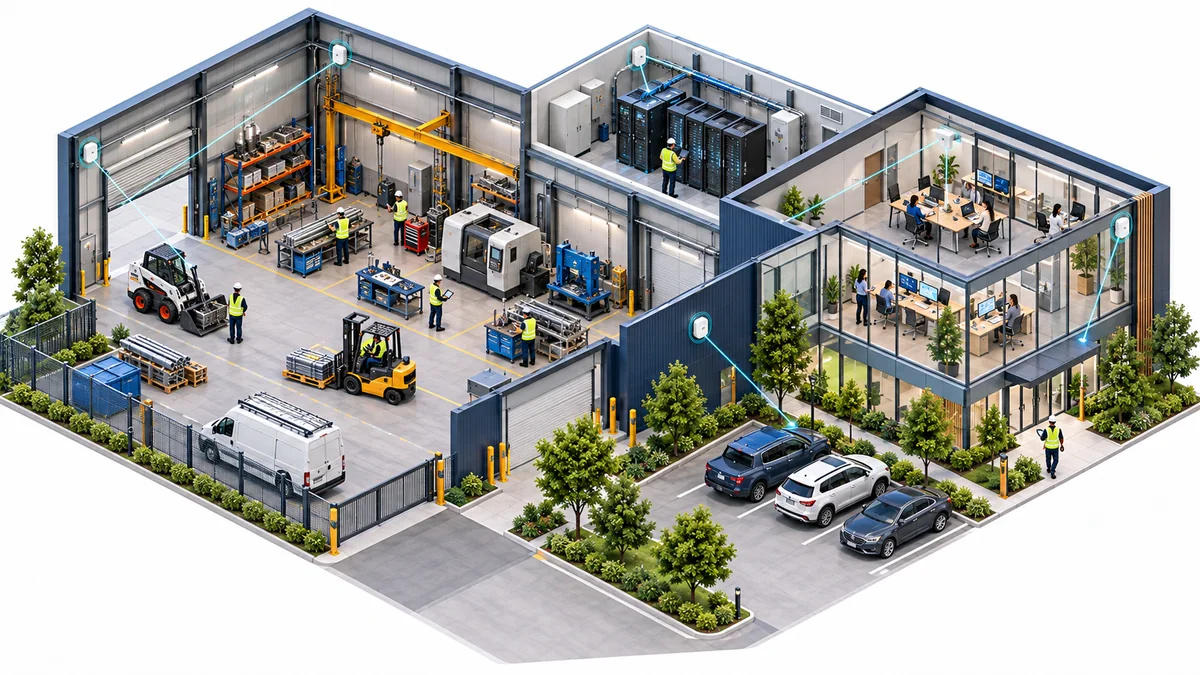
A starter bundle covers one radio’s footprint. A working warehouse network — the kind that keeps forklift scanners, cameras and AMRs connected across high racking — needs a survey, an RF design, multiple radios, cabling, commissioning and licensing. Priced honestly per square metre, that engineering lands at roughly £4–£10 per sq m for warehouses from 5,000 sq m (ex VAT, modelled from our current price book, including survey, design, installation, commissioning, radio licences and first-year support) — about £10.40 per sq m at 5,000 sq m, £5.80 at 10,000, and under £4 by 20,000. Smaller buildings are priced per project because the fixed engineering dominates. The totals behind those rates are in the table; every real site is priced from a survey.

One scope note: these bands price straightforward data and connectivity use cases — scanners, cameras, vehicles, sensors, voice. Ultra-low-latency automation (robotics safety loops, motion control, sub-10ms budgets) is a different design conversation, specified and priced from its requirements.

Notice what the numbers do as the building grows: total cost rises far more slowly than floor area. Doubling from 2,500 to 5,000 sq m adds about £6,000, because the fixed engineering costs — core, design, commissioning — are already paid for. By 20,000 sq m the effective rate is under £4 per square metre. This is the economic argument for private 5G in big buildings: each 5G radio covers what several Wi-Fi access points would, so cost per square metre collapses at scale. It is also the honest argument against it in small ones — if you only need coverage in a 1,000 sq m unit, the fixed costs dominate and Wi-Fi or an in-building repeater system (priced per project at that size) will usually beat it.

Most customers take these as a monthly cost rather than capex: on indicative 60-month finance (8% flat, subject to status), the £9,562 entry bundle is about £172 a month, a £16,800 Celona indoor kit about £302, and engineered warehouse networks run roughly £830–£1,315 a month across the £46,000–£73,000 band. Ask for the finance illustration with any quote.

Warehouse floor areaModelled installed cost (ex VAT)Approx. cost per sq m
2,500 sq m£46,000~£18.40
5,000 sq m£52,000~£10.40
10,000 sq m£58,000~£5.80
20,000 sq m£73,000~£3.65
Modelled installed cost, stand-alone private 5G for a UK warehouse (ex VAT; includes survey, design, installation, commissioning, radio licences and first-year support)

What moves the price up or down

Five factors account for most of the spread between a £9,562 bundle and a £73,000 installed system — and beyond. If you can answer these five questions about your site, you already know roughly where you land on the ladder above.

  • Coverage area and building fabric. Radio count is the biggest single driver. Open outdoor yards need few radios; dense high-bay racking, mezzanines and cold stores need more. Steel and concrete are why indoor and outdoor designs price differently.
  • Device count and traffic profile. A hundred handheld scanners is a different network from twenty 4K cameras streaming continuously. Some bundles are user-capacity tiered — the 64-user SCU2050 costs more than the base unit partly for this reason (in our bundle it also ships with a commercial AttoCore core).
  • Indoor vs outdoor. Outdoor units carry higher-power radios and weatherproofing; indoor deployments carry more cabling and access equipment. Mixed indoor-outdoor estates effectively buy both.
  • Core and licence model. Open-source core (cheapest, needs in-house skills), commercial core owned outright, subscription platform, or perpetual licence — the same radio hardware can sit £5,000–£20,000 apart depending on this choice alone.
  • Integration. Connecting the network to your WMS, existing VLANs, firewalls and device management is engineering time. A greenfield pilot needs almost none; a brownfield production site needs the most. This is the genuinely site-specific line on any quote.

Running costs: what year two looks like

The recurring costs of a private 5G network are modest, which is much of its appeal versus paying a carrier forever. Spectrum: from £80 per year per Ofcom Shared Access licence — £80 per 10 MHz of bandwidth, so £320–£800 a year for a typical 40–100 MHz channel, doubled for medium-power urban sites (one licence per area/frequency block — a single-site network typically needs very few; check Ofcom’s current fee schedule). Subscriptions: if you chose a subscription core (Ataya, Celona), that renewal is your main recurring line, which is exactly why we publish the 1/3/5-year Ataya pricing side by side. SIMs are physical items you own rather than a per-month carrier bill (on subscription platforms like Celona they come bundled with the service); the Celona kits ship with 20 or 40 included. Support: first-year support is included in our installed systems, and ongoing support contracts after that are priced to the site — ask for the option when you request a quote. There are no per-gigabyte data charges on your own network.

Outdoor coverage: where private 5G gets cheap per square metre

The engineered modelling above prices an indoor warehouse, which is the hard case — racking, metal, dense radio planning. Outdoors the economics swing dramatically in private 5G’s favour: a single high-power outdoor radio can cover a yard, compound or open site — a kilometre-plus of reach — that would take dozens of Wi-Fi access points, mounting and cabling to blanket (low-power outdoor units cover roughly a 70–100 m radius each). Outdoor systems split into low-power units (SCU2140, SCU2050 — yards, compounds, farm clusters) and high-power radios (SCU2090, Celona AP21 — big sites, long reach). Entry starts with the outdoor bundles already priced in Tier 1 — from the Askey/Waveriders SCU2050 at £9,562 up to the high-power SCU2090 at £18,498 — and engineered multi-radio outdoor networks are priced from a survey, with far lower cost per square metre than any indoor build.

This is why private 5G economics are strongest on the big open sites: mines and quarries, ports and terminals, farms and rural estates, construction sites, logistics yards. A handful of high-power radios delivers massive coverage — kilometres, not corridors — for not a lot of money, carrying vehicles, cameras, sensors and people on one secure network. If your site looks like that, the per-sq-m arithmetic above barely applies: you are buying coverage by the hectare. See how that plays out in https://senecaenterprise.com/verticals/mining/, https://senecaenterprise.com/verticals/maritime/ and https://senecaenterprise.com/verticals/agriculture/.

Here is what that looks like modelled from the same price book and the same radio-sizing model our calculators use — an illustrative surface mine of around 100 hectares (1,000,000 sq m), which the sizing model covers with four high-power outdoor radios:

ComponentCost
4 × high-power outdoor radios (SCU2090-class)£29,260
Core, server, timing and switching£13,600
Per-radio core licences (4 × £2,100 — radio software, not Ofcom spectrum)£8,400
Survey, install and commissioning (11 days)£11,500
First-year support (Tier 3)£5,358
TOTAL — about 7p per square metre≈ £68,000 ex VAT (≈ £1,230/month on 60-month finance)
Illustrative engineered outdoor private 5G — ~100-hectare surface mine (modelled from our current price book and radio-sizing model, ex VAT; travel and accommodation priced per site; every real site priced from a survey)

Those same four radios cover the sizing model’s whole 93–149 hectare mining band, so at the top of the band the same ≈£68,000 system is under 5p per square metre. The model sizes the other outdoor scenarios the same way — the mine is shown again for comparison:

ScenarioRadiosTotal ex VATPer sq mPer month (60-month finance)
Construction site, ~9 ha3≈ £58,000~62p≈ £1,040
Refinery / process plant, ~46 ha7≈ £101,000~22p≈ £1,810
Surface mine, ~93–149 ha4≈ £68,0007p falling to 5p≈ £1,230
Port / terminal, ~186 ha9≈ £121,000~6.5p≈ £2,180
Other outdoor scenarios, sized from the same model (Seneca price book, ex VAT; every real site priced from a survey)

Notice the refinery: less than half the mine’s area, yet seven radios. Dense steel and process structure absorbs signal, so obstruction — not acreage — drives the radio count. That is exactly why every real site is priced from a survey.

When private 5G is the wrong answer

An honest cost page should say who shouldn’t spend this money. If your problem is office laptops, guest access, or coverage in a normal-sized building, enterprise Wi-Fi is cheaper and entirely adequate — private 5G earns its premium on mobility at scale (roaming devices that must not drop), deterministic coverage across metal-heavy space, and outdoor estates where trenching cable is unaffordable. If your problem is phone signal — staff can’t take calls indoors — you don’t need a private network at all: an engineered repeater system at around £3–£7 per sq m is the right tool, and our in-building mobile coverage guide covers it. And for many machine-data applications, private 4G/LTE under the same Shared Access framework (typically in its 1800 MHz or 2300 MHz shared bands, where 4G kit is plentiful) does the job at lower device cost — our 4G vs 5G capability comparison sets out where each generation genuinely earns its keep. Where private 5G does fit, the strongest cases we see are in manufacturing and Industry 4.0 and logistics and warehousing.

Getting an exact price for your site

The ladder is simple: if you want to prove private 5G on your site, buy a starter bundle from the shop — from £9,562, on air within weeks, with our engineers on the remote implementation day. If you need engineered coverage across a warehouse or campus, the modelled bands above tell you what budget to hold, and a survey turns that into a fixed quote. Our technology overview and resources library cover the underlying architecture if you want to go deeper first. When you’re ready for a number with your building’s name on it, tell us about the site and we’ll price it properly — a real figure from a real survey, not “it depends”.

Frequently asked questions

How much does a private 5G network cost for a warehouse?

From our current price book, a stand-alone installed private 5G network models at about £46,000 ex VAT for a 2,500 sq m warehouse, £52,000 at 5,000 sq m, £58,000 at 10,000 sq m and £73,000 at 20,000 sq m — including survey, design, installation, commissioning, radio licences and first-year support. Every real site is priced from a survey, but these bands are reliable budget figures.

What is the cheapest way to get a private 5G network in the UK?

A ready-to-deploy starter bundle. Our Askey/Waveriders SCU2050 outdoor bundle is £9,562 inc VAT with an open-source Open5G2GO core, and includes a full day of remote implementation support. You handle the physical mounting; we help commission it. Bundles are built to order in around 30 days.

Do I need an Ofcom licence for private 5G, and what does it cost?

Yes — private 5G in the UK runs in the 3.8–4.2 GHz shared block (the upper part of 5G band n77) under Ofcom’s Shared Access licensing framework. A licence costs £80 per 10 MHz per year — typically £320–£800 a year for a usable 40–100 MHz channel, and high-power outdoor radios need a medium-power licence per radio (check Ofcom’s current fee schedule). It’s an application, not an auction, and for installed systems we handle the licensing as part of the project.

What’s actually included in a private 5G starter bundle?

Every bundle includes the small cell radio, a 5G core (open-source, commercial, subscription or perpetual licence depending on the bundle) and a full day of remote implementation support from our engineers. The Celona kits also include SIMs — 20 with the indoor kit, 40 with the outdoor kit. All are built to order in roughly 30 days.

Is private 5G cheaper than Wi-Fi?

It depends on what the comparison includes. As a rule of thumb, Wi-Fi wins below a few thousand square metres because private 5G carries fixed core and engineering costs — but that assumes the Wi-Fi cabling and containment are already in place. Where they are not, every access point brings its own cabling, switching and installation, and that infrastructure bill closes much of the gap. At scale the position reverses outright: each 5G radio covers what several Wi-Fi access points would, and our modelled warehouse pricing falls from about £18 per sq m at 2,500 sq m to under £4 per sq m at 20,000 sq m. And capex is rarely the whole answer. The better comparison is a business case: if unreliable Wi-Fi is costing downtime — dropped scanners, stalled vehicles, lost picks — that cost sits in the calculation alongside the hardware, and it is often what decides it. We build that business case with you from a survey.

What are the ongoing running costs of a private 5G network?

From £80 per year per Ofcom Shared Access licence (£80 per 10 MHz — £320–£800 a year for a typical 40–100 MHz channel), any core subscription renewal if you chose a subscription model (the main reason we publish Ataya’s 1, 3 and 5-year pricing side by side), and an optional support contract after the included first year on installed systems. There are no per-gigabyte data charges — you own the network.

Can you finance a private 5G network?

Yes — most systems go out on 60-month terms. Indicatively (8% flat, subject to status): the £9,562 starter bundle is about £172 a month, a £16,800 Celona indoor kit about £302 a month, and engineered warehouse networks roughly £830–£1,315 a month depending on size. We provide a finance illustration alongside every quote.

Ready for a number with your building’s name on it? Get a fixed, survey-based quote at senecaenterprise.com/get-a-quote/ — or buy a starter bundle today at shop.senecaenterprise.com.