No Fibre Between Buildings? Point-to-Point Wireless Links Explained (and What They Cost)

No Fibre Between Buildings? Point-to-Point Wireless Links Explained (and What They Cost)

The short answer

A point-to-point wireless link connects two buildings using a pair of roof-mounted radios instead of buried fibre. With clear line of sight, a modern mmWave link carries 1–10 Gbps over hundreds of metres to several kilometres, installs in days rather than months, and usually costs a fraction of trenching fibre across the same ground.

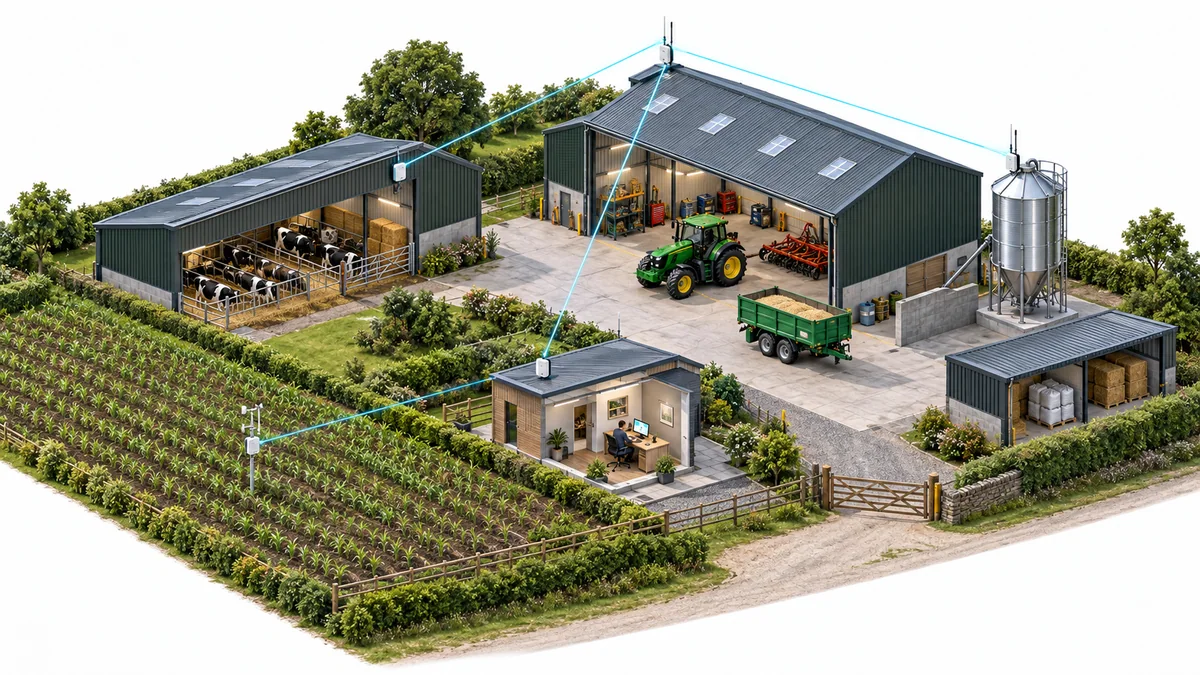
You have connectivity in one building and none in the other. Between them sits a yard, a car park, a public road, a field — or three months of Openreach lead time and a trenching quote that made the project stall. This is one of the most common problems we survey: two warehouses across a yard, a farm office and a shed 400 metres apart, a weighbridge at a remote gate, a site compound that needs to reach the main office network. In almost every case, a point-to-point (P2P) wireless link solves it faster and cheaper than digging. Here is how the technology options actually compare, what drives the price, and how to work out which one your site needs.

When a wireless link beats digging fibre

Fibre between two buildings you own sounds simple until you price the civils. Trenching means groundworks contractors, reinstatement, and a per-metre cost that climbs sharply the moment the route crosses tarmac, concrete, drainage or anything you cannot see on a plan — digging carriageway in the UK runs around £120 per metre before traffic management and oversite costs are added, so a hundred metres of road crossing can cost more than a complete installed E-band link. If the route crosses land you do not own — a shared access road, a neighbour’s field, the public highway — you add wayleaves, permits and months of negotiation before a spade touches the ground. Leased fibre from a carrier avoids the digging but often replaces it with an excess-construction charge and a multi-year contract for a link between two buildings fifty metres apart.

A point-to-point wireless link replaces all of that with two radios, one on each building, aligned at each other. If the buildings can see each other — and often they can, or can be made to with a small mast — the link goes live in days. There is no third party in the middle, no monthly circuit rental on any band (the licensed options carry an annual Ofcom licence fee instead — about £50 per link for E-band, a few hundred pounds or more for fully licensed microwave), and if you ever relocate, the hardware moves with you. The trade-off is that wireless needs line of sight and sensible engineering; a badly specified link on a congested band will cause exactly the reliability complaints that give wireless a bad name. The technology choice is where most projects go right or wrong, so that is worth understanding properly.

The four technology options, honestly compared

P2P wireless splits into four options: unlicensed 5 GHz, licence-exempt 60 GHz, light-licensed 70/80 GHz mmWave (E-band), and traditional licensed microwave. Each has a legitimate use case, and each gets mis-sold into the wrong one.

5 GHz is the budget option — the same spectrum your Wi-Fi uses. Hardware is cheap and links of several kilometres are achievable. The catch is that the band is shared: every other Wi-Fi network and wireless ISP in range is a potential interferer, and performance that was fine at install can degrade a year later when a neighbour lights up their own link. Fine for a farm shed needing internet; risky as the sole backhaul for a business-critical site network.

The mmWave pair — 60 GHz and 70/80 GHz — is where the interesting engineering lives, and it is a core Seneca capability. These frequencies carry multi-gigabit capacity — 1 to 10 Gbps on current hardware, full duplex on E-band radios — through pencil-thin beams that barely interfere with anything. 60 GHz is licence-exempt in the UK but oxygen absorption keeps typical links to around a kilometre, though long-range models using the upper channels reach several kilometres. 70/80 GHz (E-band) links are light-licensed through Ofcom’s self-coordinated scheme, which gives you a registered, interference-protected link over several kilometres for a small annual fee of around £50 per link — check Ofcom’s current fee schedule. For fibre-like capacity between buildings, E-band is usually the right answer.

Traditional licensed microwave (bands such as 13, 18 and 23 GHz) trades capacity for distance: hundreds of Mbps to low Gbps, but over 10 km or more, with full Ofcom link coordination and protection. It is the tool for genuinely long hops — estate to estate, hilltop to remote site — where mmWave cannot reach. The table below puts the four options side by side.

OptionLicensing (UK)Typical real-world capacityRealistic rangeInterference riskWhat they cost (indicative, installed, ex VAT)
5 GHz unlicensedNone (shared band)100–500 Mbps1–10 kmHigh — shared with Wi-Fi and other links; can degrade over time£100–£5,000
60 GHz mmWaveLicence-exempt1–2 Gbps+Up to ~1–2 km typical (long-range models further)Very low — narrow beams, oxygen absorption isolates links£400–£5,000
70/80 GHz mmWave (E-band)Ofcom light licence, self-coordinated1–10 Gbps1–5 kmVery low — registered and coordinated£5,000–£11,000
Licensed microwave (13/18/23 GHz)Ofcom link licence, coordinated300 Mbps–2 Gbps5–20 km+Very low — fully protected£5,000–£20,000
Point-to-point wireless options compared

What a point-to-point link actually costs

Context matters more than any single number here, because the price bands span two different classes of kit. The lower price bands are business-grade radios — Ubiquiti, MikroTik and similar — excellent value for yards, farms and ordinary business links. The upper price bands are carrier-grade systems: engineered mounting, licensed spectrum, guaranteed availability, the class we deploy where the link is business-critical. The same idea, built to a very different duty.

Few installers publish all-in installed prices for either class, so here is the structure of a real quote. The hardware itself is often the smallest line on the quote. A complete installed link is hardware plus survey, mounting, cabling, alignment, configuration and — where applicable — licensing, and four things move the total more than the radio choice does.

Height and access. Two radios on single-storey buildings reachable from a tower or scaffold cost far less to install than radios at 20 metres needing a cherry picker, roof permits or steelwork. Access equipment and working-at-height requirements are frequently the largest variable on the whole job.

Line of sight. If the buildings see each other cleanly, you are done. If a tree line, silo or third building blocks the path, you need a mast, a relay hop, or a rethink — each adding cost. This is exactly what a survey establishes before anyone commits money.

Licensing and coordination. Licence-exempt 60 GHz adds nothing. E-band adds a small annual Ofcom fee. Fully licensed microwave adds coordination work and higher recurring fees, justified only when the distance demands it.

Resilience. A single link is a single point of failure. Business-critical sites often specify a second link on a different band as automatic failover — roughly doubling hardware but transforming availability.

As indicative totals: a straightforward short-hop link between two accessible buildings typically lands between £100 and £5,000 installed, a multi-gigabit E-band link with proper mounting and licensing typically runs £5,000–£11,000, and licensed microwave links span £5,000–£20,000 (all ex VAT, indicative — the survey settles it). Compare that with trenching, which can exceed those figures in the first fifty metres of tarmac.

Where these links earn their keep: real scenarios

Two warehouses across a yard. The classic case. A 60 GHz or E-band link puts the second warehouse on the main LAN at gigabit speeds — scanners, VoIP, CCTV and office traffic all behave as if the buildings were patched together. No trench across the yard the forklifts use all day.

Farms and rural estates. Getting internet to outbuildings without digging fibre is exactly what 5 GHz and 60 GHz links were made for: broadband arrives at the farmhouse, and links distribute it across the yard to sheds, grain stores and cottages. Long-distance CCTV is the same pattern in reverse — cameras on a remote barn backhauled over a wireless link to the NVR, rather than a standalone 4G camera betting on a single operator’s mast, which can be congested. Where the estate’s fixed broadband is itself too slow to carry the camera streams offsite, we pair the link design with better backhaul — see our multi-network SIM options at https://shop.senecaenterprise.com for cellular fallback.

Weighbridges and remote gatehouses. A weighbridge at a site entrance 300 metres from the office needs a reliable, low-latency connection for its terminal, ANPR camera and intercom. A small P2P link delivers all three over one hop, powered from the gatehouse.

Construction and temporary compounds. Site compounds needing to reach the main office network — or two compounds needing to reach each other — suit wireless precisely because it is redeployable: when the project ends, the radios come down and move to the next site. For the wider temporary-connectivity picture, see https://senecaenterprise.com/technology/ for how P2P links combine with fixed wireless access and private networks.

One more option worth knowing at estate scale: where you need to connect several outbuildings, compounds or assets rather than just two points, a private 5G network can serve many endpoints from one radio — depending on the use case it can beat a mesh of point-to-point links. See what that costs at https://senecaenterprise.com/private-5g-network-cost-uk/.

How Seneca designs and installs P2P links

We are engineers first: every link we quote starts with a desktop path analysis — distance, terrain, Fresnel clearance, rain-fade margin for the band — followed by a physical site survey confirming line of sight, mounting positions, power and cable routes. That survey is what separates a link that runs for ten years from one that drops every time it rains. We then specify the band honestly: if a few-hundred-pound radio pair genuinely solves your problem, that is what we will tell you, and if your capacity or reliability requirement justifies E-band, we will show the numbers behind that too.

Installation covers mounting, lightning protection, alignment to the link budget, and integration with your network — VLANs, failover routing and monitoring included, so the link is a managed part of your infrastructure rather than a mystery box on the roof. Where sites also suffer poor mobile coverage or need cellular resilience, we fold that into the same design; our mmWave capability sits alongside private 5G, Wi-Fi and in-building coverage work described at https://senecaenterprise.com/technology/.

Next step: find out if your buildings can see each other

Most P2P projects live or die on one question — is there a clean path between the two points? We can usually answer that from a desktop study within days, and confirm it with a site survey before you spend anything on hardware. Send us the two locations and what you need the link to carry, and we will come back with a banded design and cost. Start at https://senecaenterprise.com/get-a-quote/ for a full survey and design, or use https://senecaenterprise.com/quick-quote/ if you just want a fast sanity check on feasibility and budget.

Frequently asked questions

How much does a point-to-point microwave link cost to install in the UK?

It depends mostly on height and access, line of sight and the band, not the radio hardware. As a guide, a short-hop unlicensed or 60 GHz link between two accessible buildings typically lands between £100 and £5,000 installed, while a multi-gigabit E-band link with licensing and proper mounting typically runs £5,000–£11,000 ex VAT. A survey turns those bands into a fixed number for your site.

How much capacity can an mmWave link carry between sites?

Current 60 GHz hardware delivers 1–2 Gbps over links typically up to a kilometre or two (long-range models reach several kilometres), and 70/80 GHz E-band equipment carries 1–10 Gbps full duplex over one to five kilometres. That is genuine fibre-class capacity — enough to treat two buildings as one LAN, including CCTV, VoIP and file traffic simultaneously.

Can I run CCTV over a wireless link on a farm, over a long distance?

Yes — this is one of the most common uses. Cameras at a remote barn or gateway are backhauled over a 5 GHz or 60 GHz link to the NVR at the main building, giving more consistent, reliable footage than standalone single-SIM 4G cameras. A handful of HD cameras needs only tens of Mbps, well within reach of even budget links, provided the path is surveyed properly.

How do I get internet to outbuildings without digging fibre?

Bring broadband into one building, then distribute it with point-to-point wireless links to each outbuilding — a radio pair per hop, mounted with clear line of sight. Across a farm yard or between sheds, short 5 GHz or 60 GHz links install in a day each and avoid trenching entirely. Where no decent fixed broadband exists at all, cellular routers with multi-network SIMs can provide the feed instead.

Do I need a licence for a point-to-point wireless link in the UK?

Not always. 5 GHz and 60 GHz links are unlicensed or licence-exempt. 70/80 GHz E-band links need an Ofcom light licence under the self-coordinated scheme — a quick registration with a small annual fee that buys you interference protection. Traditional licensed microwave bands require full link coordination, which we handle as part of the installation.

Can a wireless link connect a site compound to the main office network?

Yes, and it is often the best fit for temporary sites because the equipment is redeployable. A P2P link puts the compound on the office LAN — same VLANs, phones, printers and security policy — with no circuit lead time, and when the project ends the radios come down and move to the next job.

Tell us the two locations and what the link needs to carry — get a banded design and cost at https://senecaenterprise.com/get-a-quote/