100 Mbps+
Broadband transformed in a rural deployment
A rural community moved from around 2 Mbps to 100 Mbps or more after a network upgrade. The result shows the difference a new connection can make to remote homes and businesses.

Home / Private 5G / Hard-to-Reach Rural Broadband
Private networks / Hard-to-Reach Rural Broadband
Turn a collection of poorly connected properties into a connected community. We design rural broadband around the homes, businesses and working land that need it, using private 5G and fixed wireless access where they fit.
Bring an internet connection into the area, distribute it to the properties, and make it useful inside each building. From a home office to a remote workshop, the whole journey matters.
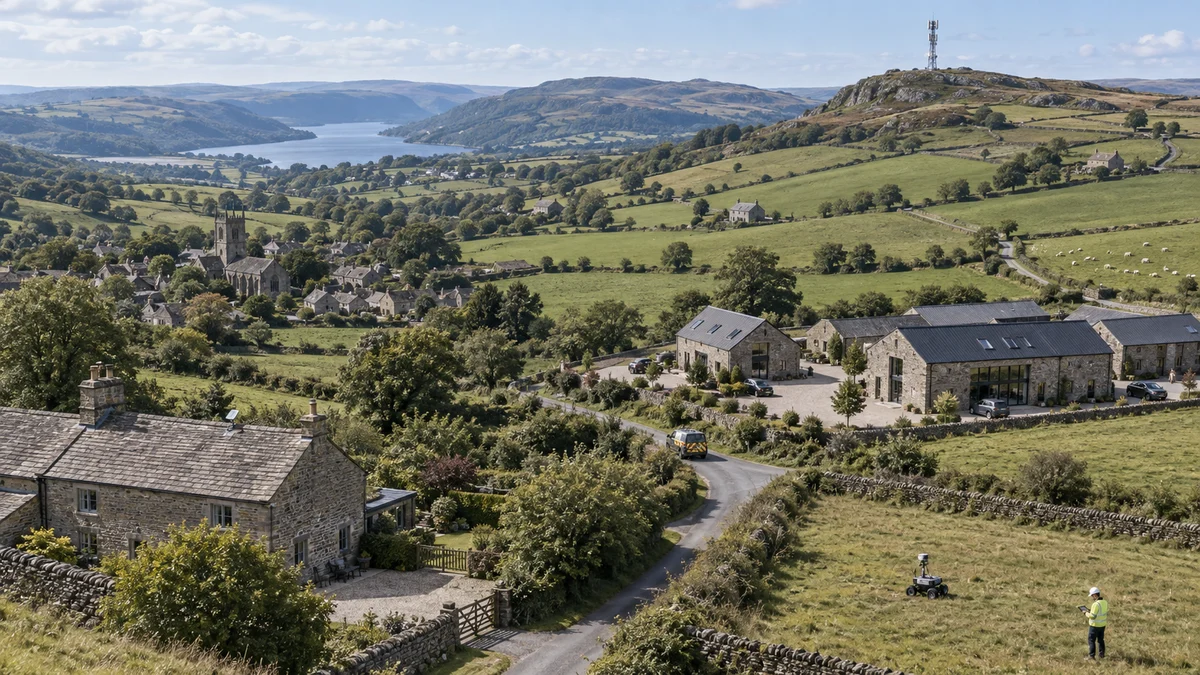
Private 5G in practice
100 Mbps+
A rural community moved from around 2 Mbps to 100 Mbps or more after a network upgrade. The result shows the difference a new connection can make to remote homes and businesses.
Shared reach
Private cellular coverage distributes an internet connection across separated homes and business premises, extending service beyond the reach of individual cable routes.
Building Wi-Fi
A private 5G router feeds local Wi-Fi access points, giving familiar phones, laptops and office devices a connection inside the building.
The operational connection
A rural business can have customers across the country and still struggle to upload an invoice. A village can sit close to a fibre route while outlying homes remain beyond its reach. The challenge is joining the available internet connection to the places where people actually live and work.
A local wireless network distributes broadband from a suitable connection point to receivers at individual properties. Each receiver feeds the building’s Wi-Fi or wired network. Private 5G can also connect estate equipment, cameras and robots, with edge AI processing selected observations locally.
Practical hard-to-reach rural broadband use cases
A consultant living beyond the village’s fibre footprint starts the morning with a client video call and a shared project file. A receiver at the property connects to the local private 5G network, which carries traffic to the area’s internet connection. Inside the house, a properly placed Wi-Fi network serves the office and everyday household devices.
The community deployment brings neighbouring properties into the same planned service, with capacity sized for the busy periods rather than just a single demonstration. New connections can be added as demand grows. The household has a clear support route for the service, and the working day no longer has to be organised around finding somewhere else to upload a file.
A rural estate converts an outlying barn into workshops for local businesses. A wireless receiver brings connectivity to the building, while separate local networks serve tenants, payment terminals and estate systems. Staff use their normal online tools, confirm orders and share drawings without returning to the main office for a connection.
The estate manager adds a connected gate camera and a local edge AI application that flags a vehicle stopped at a service entrance outside agreed hours. A short clip reaches the responsible person for review. Business broadband and estate operations share planned infrastructure with separate access, giving the new workspace useful services from the day it opens.
An estate inspection robot makes a scheduled round of an outlying water-pump building, capturing thermal images and equipment readings. Private 5G carries the observations to local edge AI, which highlights a temperature change against previous rounds. The facilities team receives the asset reference and selected images together, rather than a long recording to search.
An engineer reviews the finding, assigns a visit and checks the relevant maintenance notes before leaving the workshop. After the work, the next robot round provides a fresh set of observations for comparison. The network supports the reporting workflow, while the robot’s onboard systems handle movement and the engineer owns the maintenance decision.
Robotics and edge AI
Connect an inspection robot at a remote building to the engineering team, with local edge AI highlighting changes in the observations. The same infrastructure can support estate cameras and sensors alongside separately managed broadband services.
Choose what the application should identify and who receives the result. A reviewed finding can become a work order, a confirmed handover or a record for the next shift, with the supporting evidence kept alongside it.
Explore private AI → Private compute → Managed open-source applications →
Built around the operation
Start with the properties, terrain, trees and suitable equipment locations. Compare available fibre, fixed wireless, mobile and satellite connections for the internet feed, then design the local distribution and indoor coverage together.
Size the internet feed and radio capacity for concurrent household and business demand. Agree property installation, power, support and expansion arrangements, and keep operational devices separate from household traffic.
Planning & costs
We assess your estate, devices and applications, then design connectivity around the work you want to improve. We help build a business case around the opportunity, deployment costs and ongoing support.
We handle the technical assessment and help connect the investment to useful results. The first conversation starts with what you want to achieve.
Start with a focused deployment and expand, or move ahead with a full programme. We shape delivery around your priorities and readiness, and coordinate installation with your operation.
Talk to our teamPlanning questions
It provides the local wireless connection. Internet access also needs an upstream service, often called backhaul. We design that feed, the local network and the receiver at each property as one service.
Compatible cellular devices connect directly; suitable gateways can link other equipment. We check the exact device models, interfaces and application requirements before choosing the design.
Selected analytics can run on local servers, with access and storage designed around the workflow. The application identifies agreed events; staff review the result and retain responsibility for the operational response.
A site plan, the chosen task, device details and the applications involved provide a useful start. We then assess coverage, integration, installation and ongoing support for a defined proposal.
Read the private 5G cost guide →Your operation, connected
Show us the working area, the equipment and the point where information stops flowing. We’ll help turn it into a practical first project.
Coverage and performance are designed around your site, devices and applications. We set out the agreed service and delivery scope in your proposal.
Use cases illustrate how the service can support an operation. Project specifications and commercial terms are confirmed in the agreed proposal and contract.