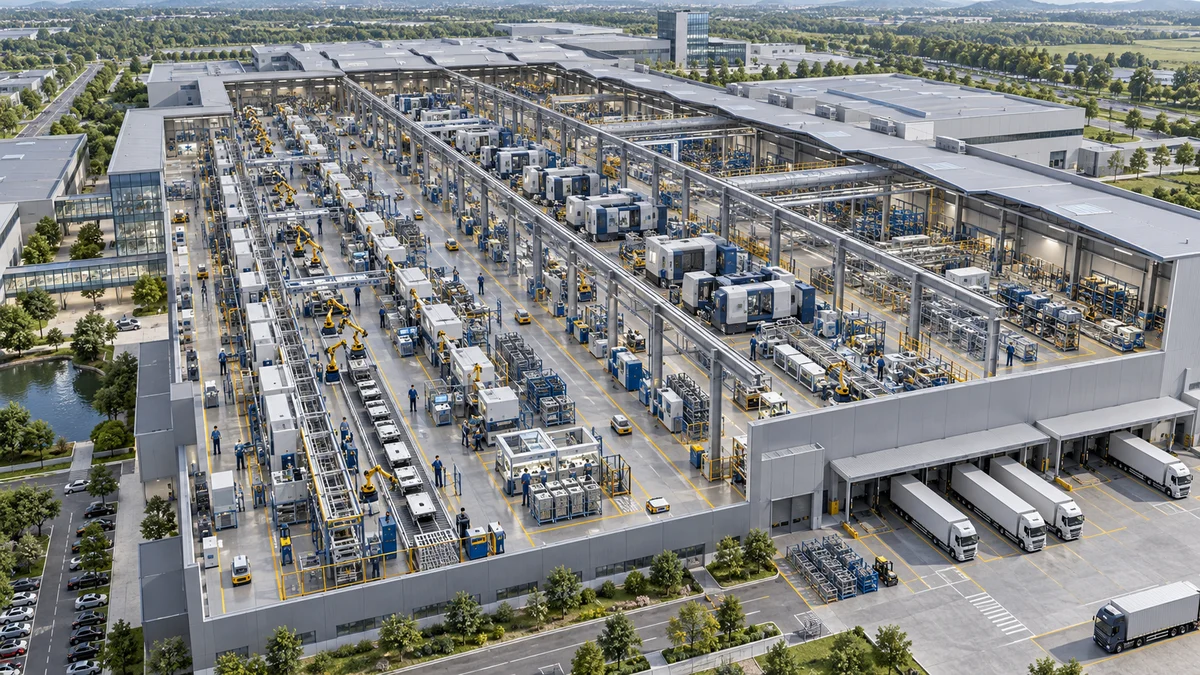
Private 5G for manufacturing. Keep production moving.
Connect the people, machines and material movements that keep your factory running. Private 5G brings mobile robots, inspection cameras and production applications onto a dedicated network built around your operation.
Get components to the right station. Put inspection results in front of the quality team. Give engineers machine information while there is still time to act. Connect the factory floor with the systems that turn those events into decisions.
More useful production from the equipment you have.
5–15%
Potential improvement in equipment effectiveness
Connected manufacturing offers a 5–15% equipment-effectiveness improvement opportunity through fewer interruptions and shorter changeovers. Overall equipment effectiveness combines availability, speed and quality.
5–10%
Potential improvement in first-pass yield
Connected inspection offers a 5–10% first-pass yield improvement opportunity by identifying defects during production, helping more items pass inspection without rework.
€245k/year
Modelled annual value from recovered forklift time
Recovering 30 minutes a day across 20 forklifts produces €245,000 of annual time value at €98 per hour over 250 working days.
From production plan to finished product
Keep the next station ready for the next job.
A production line depends on hundreds of handovers. A component arrives, an operator confirms a build step, an inspection releases the batch and the next workstation takes over. When the information falls behind, people leave the task to find a part, check a record or chase an update.
Private 5G connects mobile equipment and workers to the applications managing those handovers. It gives your team control over device access and traffic priorities across production halls, stores and outdoor routes, with coverage planned around the work rather than the office layout.
Connect the information that moves production.
Material requests reach the robot fleet and stores team.
Inspection images reach local quality applications.
Give every movement and decision a useful connection.
Start with an everyday production task, then connect the equipment, people and applications that complete it.
01
Turn a robot dog’s inspection into a coordinated SHEQ response
A robot dog patrols its inspection route through the factory and spots a fluid leak beside a production line. Its inspection system captures images and tags the finding with the asset reference and location. Private 5G carries the alert and live camera feed to the safety, health, environment and quality (SHEQ) team. The supervisor reviews the finding and brings the relevant teams into one shared incident record, with a clear view of the issue before they arrive.
The safety and health team assesses the risk to colleagues, the environmental lead reviews the potential impact, and quality checks whether nearby materials or products need attention. Maintenance records the repair, while the responsible managers assign follow-up actions and capture evidence of completion. The next shift can see what happened, what has been resolved and what remains open, without piecing together radio calls, paper forms and separate messages.
The opportunity: faster reporting, clearer ownership of SHEQ actions and a complete record from first alert to close-out.
02
Catch the defect before it becomes a batch problem
A camera inspects a finished assembly as it leaves the workstation, sending images over private 5G to an on-site vision application. The application flags a missing part, damaged surface or incorrect label for the quality team and attaches the result to the production record. The inspector can review the image while the item is still close to the line.
As a pattern emerges, the team can trace the affected items to a machine, material batch or changeover and investigate the cause. Wireless inspection stations can move with a revised line layout, bringing checks closer to the step that matters. Private compute keeps the image processing local, and the quality workflow brings the result to the people who decide what happens next.
The opportunity: earlier defect detection, better batch traceability and less work repeated further down the line.
03
Turn a changing machine reading into a planned intervention
A motor’s vibration trend changes during a production run. Connected sensors send readings through a suitable gateway over private 5G to the condition-monitoring application. The system presents the trend alongside temperature, running hours and recent work, giving the engineer a useful starting point for investigation.
The engineer checks the history on a tablet beside the asset, records the inspection and raises a work order for the next suitable production window. Stores can prepare the part and the supervisor can see the planned intervention before the shift changes. The network brings the readings and the work record together, so the team can act on the information instead of collecting it again.
The opportunity: earlier awareness of developing faults, better-prepared maintenance and clearer shift handovers.
Connected workers
Bring the production record to the point of work.
An operator scans a job, opens the current instruction and records a completed check without leaving the station. A supervisor reviews an exception on a tablet while walking the line. Private 5G connects those devices to the approved applications throughout their working routes.
Connected handsets and worker-assistance applications also help supervisors coordinate across larger halls and service areas. A request for help reaches the right team, while digital incident and handover records keep the next shift informed.
Give each role the information and access it needs, from a temporary contractor’s task list to the quality team’s inspection record.
A network around your operation
Connect the floor to the systems running the factory.
01 / Production devicesRobots, cameras, sensors, industrial gateways and operator tablets
02 / Working areasAssembly lines, machining halls, stores and inter-building routes
03 / Private networkDevice identities, radio coverage, traffic priorities and controlled access
04 / Factory applicationsProduction management, fleet software, quality records and maintenance systems
Fit the existing production environment
The manufacturing execution system records what is being built; fleet and quality applications manage their own tasks. We bring these interfaces into the design alongside existing wired networks and Wi-Fi. Access controls separate production equipment, business users and support access, with a clear route between each device and its application.
Plan for movement and change
Steel structures, machinery, moving stock and crane routes shape radio coverage. Camera uploads and mobile robot traffic have different demands, so the design includes capacity and priorities for each workflow. Equipment control and safety functions remain engineered with the machinery supplier as part of the complete system.
We help turn the opportunity into a working solution.
We assess your estate, devices and applications, then design connectivity around the work you want to improve. We help build a business case around the opportunity, deployment costs and ongoing support.
We handle the technical assessment and help connect the investment to useful results. The first conversation starts with what you want to achieve.
One area or the whole estate.
Start with a focused deployment and expand, or move ahead with a full programme. We shape delivery around your priorities and readiness, and coordinate installation with your operation.
Where does private 5G fit alongside industrial Ethernet and Wi-Fi?
It adds a managed mobile connection for selected equipment and workflows. Wired links can continue serving fixed machinery, while Wi-Fi supports suitable users and devices. We choose the connection around the task, mobility and application requirements.
Compatible cellular equipment connects directly. Industrial gateways can link selected sensors and machines, while the application interface carries the right data into your production or maintenance system. The machine model, available interface and existing controls determine the integration.
Can inspection images stay on site?
Yes. Local servers can host the vision application and store images within your environment. Network access, retention and connections to production records are designed around the quality workflow and your data requirements.
Will private 5G connect our mobile robots?
Compatible robots or gateways can connect to fleet applications over private 5G. The design follows the fleet supplier’s interfaces and response requirements, alongside the robot’s own navigation and safety functions.
What do you need to scope the first project?
A site plan, the chosen production task, device details and the applications involved give us a useful start. We then assess coverage, integration, installation and support to prepare a defined proposal.
The improvement ranges are planning benchmarks, not measured customer results. The forklift and staff-time calculations are illustrative models. We assess your operation to build a business case and agree the deployment scope.
Information may change or contain errors. Project-specific specifications, delivery commitments and commercial terms are set out in the agreed proposal and contract. Illustrations show concepts; source records are retained by Seneca.