428.3m
Tonnes through UK ports in 2025
UK ports handled 428.3 million tonnes of freight in 2025—a scale of operation that depends on information moving with cargo, vehicles and people.

Home / Private 5G / Ports
Private networks / Ports & terminals
Connect the people, vehicles and applications that move cargo. A private 5G network gives your terminal a mobile network designed around its working areas, devices and operational priorities.
Start with the job that loses time when the connection drops: a vehicle movement that cannot be recorded, a camera feed that freezes, or a worker who has to return to the office to finish a task.
The scale of the opportunity
428.3m
UK ports handled 428.3 million tonnes of freight in 2025—a scale of operation that depends on information moving with cargo, vehicles and people.
Yard to quay
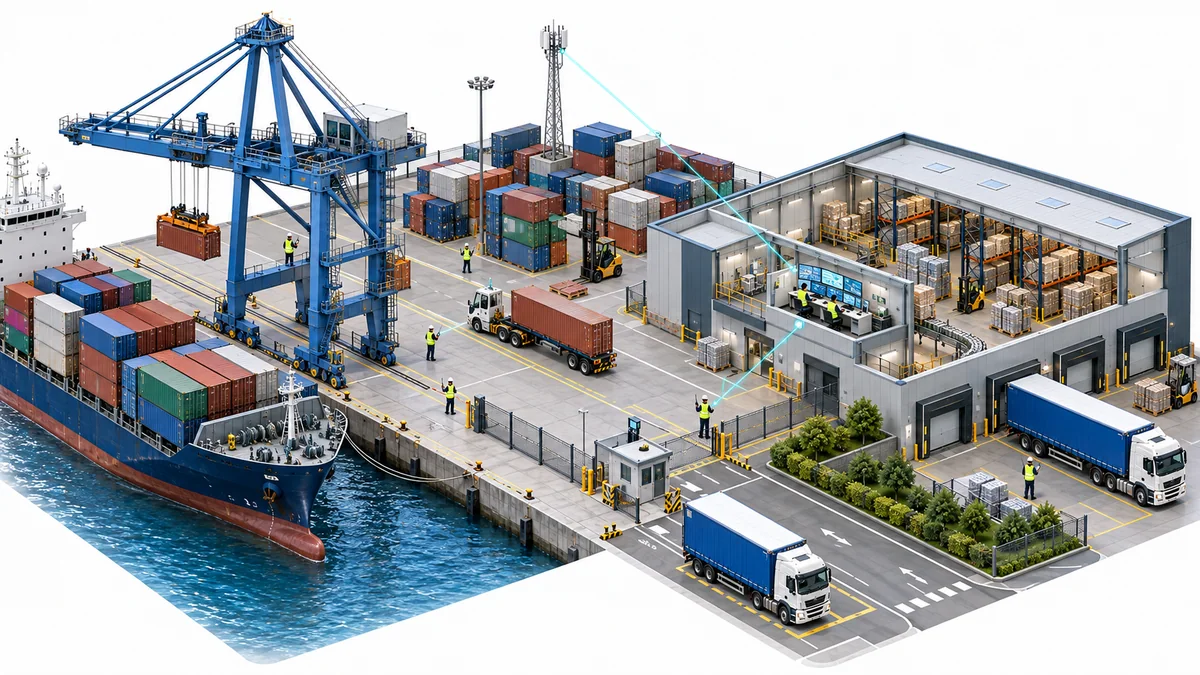
Private wireless connectivity links working areas across a commercial port, carrying operational information between the teams and equipment moving cargo.
€3k–€5k
Connected port operations achieved savings of €3,000–€5,000 per call by improving the flow of operational information over a private wireless network.
The operational problem
Container stacks move, vehicles cross large yards and temporary working areas appear between permanent buildings. The network needs to reach the routes and working areas that keep the terminal moving.
Private 5G brings dedicated mobile connectivity to these working areas, with control over which devices join and how their traffic is handled. It works alongside fibre, Wi-Fi and public mobile services as part of the wider port network.
Connect the everyday tasks that join up your port operation.
Practical port use cases
Put private 5G to work across the yard, the quay and the control room.
A container arrives at the terminal. The next available driver receives the collection job on their vehicle-mounted screen, heads to the right block and confirms the move at the destination. Private 5G connects the vehicle terminal to the port’s operating system as the driver works across the yard, keeping job instructions and completion records flowing between the cab and the control room.
For the operations team, that means a clearer view of completed moves and the next jobs to assign. Drivers spend less time chasing instructions over the radio or returning to a coverage hotspot to update a record. When connected to the terminal’s tracking and scheduling systems, the same network supports vehicle-location updates and changing priorities throughout the shift.
A loading operation stops because an engineer needs to inspect a fault. Instead of waiting for a specialist to reach the quay, the local team shares live video from a handheld device over the port’s private network. The specialist sees the equipment, asks for a closer view and helps the team decide what to do next while everyone is looking at the same problem.
The same approach connects cameras in temporary loading areas and changing work zones, bringing those views into the operations room without extending a fixed data cable to every camera position. Local video recording and processing can keep footage close to the operation and give teams a shared record for maintenance, incident review and planning.
A technician reaches a pump, gate or handling asset with the current work order already on their tablet. They open the drawing, review previous repairs and attach photographs as the job progresses. Private 5G connects the device to the maintenance system across the working area, so the record travels with the technician.
Once the work is complete, the technician updates the asset record and the next team sees the handover without waiting for end-of-shift paperwork. Add a private AI document assistant and staff can also search approved manuals and procedures from the same device, with references back to the source material. Connectivity, applications and information come together where the work happens.
Automation and remote operations
Private 5G can carry the video, telemetry and control traffic that links remote operators with cranes and automated yard vehicles. It gives automation projects a mobile connection across the terminal, bringing equipment and control-room systems into the same operational picture.
The network is designed with the equipment and automation teams around the application’s response time, availability and safety requirements. Local processing brings applications closer to the machines, while the wider network connects them to scheduling, maintenance and operational systems.
Build from today’s connected workers and vehicles towards the automation your terminal needs next.
From device to application
Capture stack heights, moving obstructions, work areas, mounting positions, power and backhaul. Test the devices and their supported frequency bands. UK spectrum availability and licence conditions need checking against the proposed location and design; Ofcom provides the relevant licensing route. Ofcom licensing guidance ↗
Define monitoring, maintenance windows, fault ownership, software updates and recovery before rollout. Map the connections to existing networks and applications. Local hosting can keep selected traffic on site, while management, support or cloud integrations may still introduce external dependencies.
Explore private compute → See the wider ports and maritime offer →
Planning & costs
We assess your estate, devices and applications, then design connectivity around the work you want to improve. We help build a business case around the opportunity, deployment costs and ongoing support.
We handle the technical assessment and help connect the investment to useful results. The first conversation starts with what you want to achieve.
Start with a focused deployment and expand, or move ahead with a full programme. We shape delivery around your priorities and readiness, and coordinate installation with your operation.
Talk to our teamPlanning questions
Not necessarily. Fibre can carry fixed backhaul and Wi-Fi can continue serving suitable buildings and devices. Assess private 5G for the mobile and outdoor workloads that benefit from it, then plan how the networks and access policies fit together.
Check the exact radio bands, SIM support, modem capabilities and application requirements of each model. Some equipment may connect through a suitable gateway. A device described as “5G” is not automatically compatible with the selected private network.
The estimate depends on the working area, radio conditions, device population, capacity, installation, core, integrations and operating model. A site plan and one well-defined use case provide a useful starting point. A lab-kit price does not represent a complete port deployment.
Read the private 5G cost guide →Yes, private 5G can support these applications as part of an integrated automation system. The network design follows the equipment supplier’s requirements for response time, availability and safe operation.
The schedule follows the survey, spectrum position, installation access, equipment availability and integration scope. Agree the milestones once those dependencies are known. The Shop’s 30-day kit lead time is an equipment ordering term, not a port go-live commitment.
Start with your terminal
Bring a site plan, the devices involved and one workflow that loses time today. We can use those to scope the coverage, integration and pilot requirements.
Website information and use cases provide general guidance. Performance, coverage, savings and suitability depend on site conditions, equipment, applications, integration and the agreed service scope. Illustrations and worked examples are indicative; third-party results relate to the original deployments.
Information may change or contain errors. Project-specific specifications, delivery commitments and commercial terms are set out in the agreed proposal and contract. The port case is a private-wireless example; its source does not specify the cellular generation or a detailed savings methodology.