Lab to campus
Take connected research beyond the bench
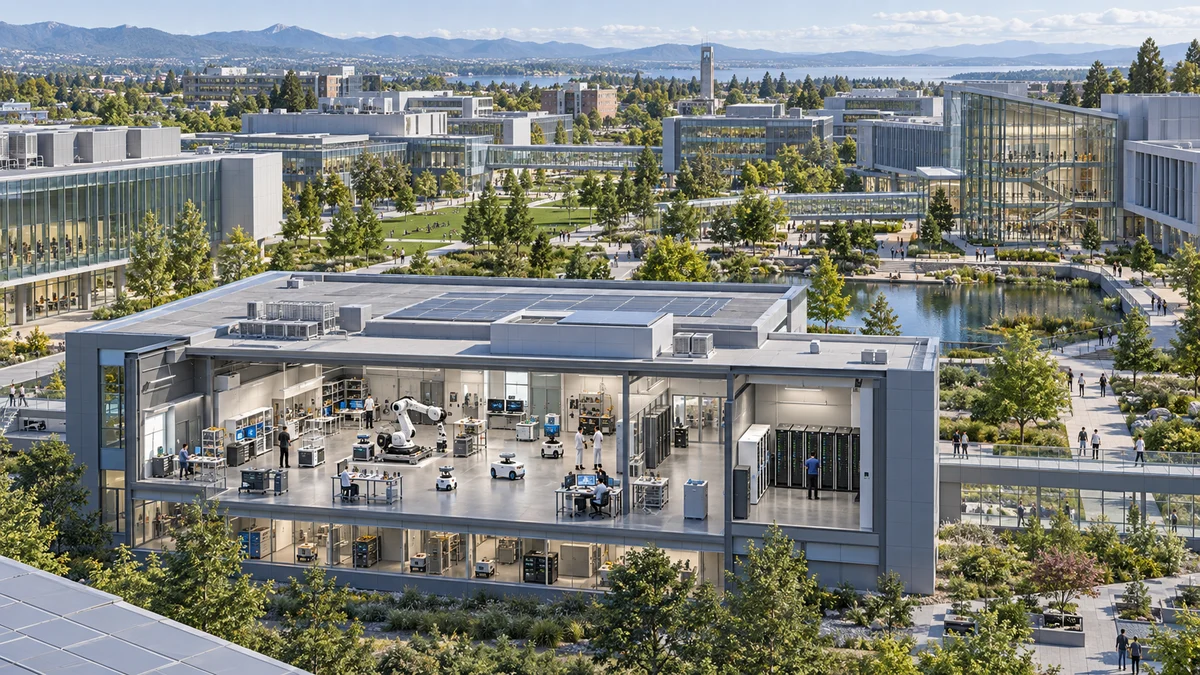
A private research network supports laboratory development and wider campus experiments, helping teams test connected systems in their intended working environment.

Home / Private 5G / Education & Campuses
Private networks / Education & Campuses
Give research teams a practical environment for connected robotics and edge AI. Private 5G links the laboratory, test route and local computing infrastructure into one usable project space.
Move from a bench demonstration to a repeatable campus trial, with clear device access, useful observations and a route into teaching and research.
Private 5G in practice
Lab to campus
A private research network supports laboratory development and wider campus experiments, helping teams test connected systems in their intended working environment.
Open development
Application interfaces and IoT integration give researchers a practical platform for developing connected services and testing how they behave.
Teaching
A working private network brings devices, applications and mobile networking into practical teaching, demonstrations and student projects.
The operational connection
A project that works on a lab bench still has to cope with movement, changing radio conditions and the application running elsewhere. A campus test environment gives researchers a way to explore those interactions with real devices.
Private 5G connects selected robots, instruments and student equipment to local applications. Teams can collect the evidence from a trial, adjust one part of the system and compare the next run without rebuilding the entire environment.
Practical education & campuses use cases
A research team equips a small delivery robot with a compatible connection and assigns a trial between two campus locations. Private 5G carries mission status and selected camera data to the lab. Students can observe how the application behaves as the robot moves through the approved test area.
The team records completed tasks, communication events and operator interventions alongside the robot’s own logs. A change to the application can then be evaluated against the same route. The experiment produces a repeatable record that supports research and teaching, with the robot’s movement governed by its operating arrangements.
A camera or robot sends images to an edge AI application on a local server. The model identifies the agreed objects or conditions and returns the result to a research dashboard. Private 5G links capture and processing, allowing the team to study the complete path rather than the model in isolation.
Researchers compare results against labelled examples and inspect the cases the model gets wrong. They can vary the workload, camera position or network conditions and retain the observations for the next cohort. Computing stays within the chosen campus environment, where access and datasets can be managed for the project.
An estates team uses a connected inspection device to record an issue along a campus service route. Photographs, asset references and notes reach the maintenance application through private 5G. A supervisor can review the finding from the office while the team is still close to the location.
The service request is assigned to the right trade, and completion evidence is attached to the same record. A research group can separately trial approved analytics on selected non-sensitive equipment images, creating a useful connection between teaching capability and estate operations. Operational ownership remains clear throughout.
Robotics and edge AI
Follow a delivery robot from the lab onto a campus route. The robot gathers observations or completes its assigned movement; the private network carries the agreed data. Edge AI means processing selected images or sensor readings on local computing infrastructure.
Choose what the application should identify and who receives the result. A reviewed finding can become a work order, a confirmed handover or a record for the next shift, with the supporting evidence kept alongside it.
Explore private AI → Private compute → Managed open-source applications →
Built around the operation
Define the lab, outdoor trial routes and buildings in scope. Plan device onboarding, student access periods and radio changes so research activity can coexist with operational users.
Choose where the core, edge compute and experiment logs run. Separate project datasets and access rights, and keep a clear record of changes between trial runs.
Planning & costs
We assess your estate, devices and applications, then design connectivity around the work you want to improve. We help build a business case around the opportunity, deployment costs and ongoing support.
We handle the technical assessment and help connect the investment to useful results. The first conversation starts with what you want to achieve.
Start with a focused deployment and expand, or move ahead with a full programme. We shape delivery around your priorities and readiness, and coordinate installation with your operation.
Talk to our teamPlanning questions
Yes, with access, capacity and change windows designed around the groups using it. A shared platform can host separate projects with clearly managed device and data access.
Compatible cellular devices connect directly; suitable gateways can link other equipment. We check the exact device models, interfaces and application requirements before choosing the design.
Selected analytics can run on local servers, with access and storage designed around the workflow. The application identifies agreed events; staff review the result and retain responsibility for the operational response.
A site plan, the chosen task, device details and the applications involved provide a useful start. We then assess coverage, integration, installation and ongoing support for a defined proposal.
Read the private 5G cost guide →Your operation, connected
Show us the working area, the equipment and the point where information stops flowing. We’ll help turn it into a practical first project.
Coverage and performance are designed around your site, devices and applications. We set out the agreed service and delivery scope in your proposal.
Use cases illustrate how the service can support an operation. Project specifications and commercial terms are confirmed in the agreed proposal and contract.