1.5 km
Private 5G underground at a mining test site
Private 5G reaches depths of up to 1.5 kilometres in a mining technology test environment, connecting equipment below the surface.

Home / Private 5G / Mining
Private networks / Mines & quarries
Keep production information moving with your people and machines. Private 5G connects haul routes, working areas and operational systems across mines and quarries, giving teams the information they need at the point of work.
Send the next load to the right destination. Connect a worker’s call for assistance with the people who can respond. Put work orders, telemetry and shift updates in the hands of the people keeping production moving.
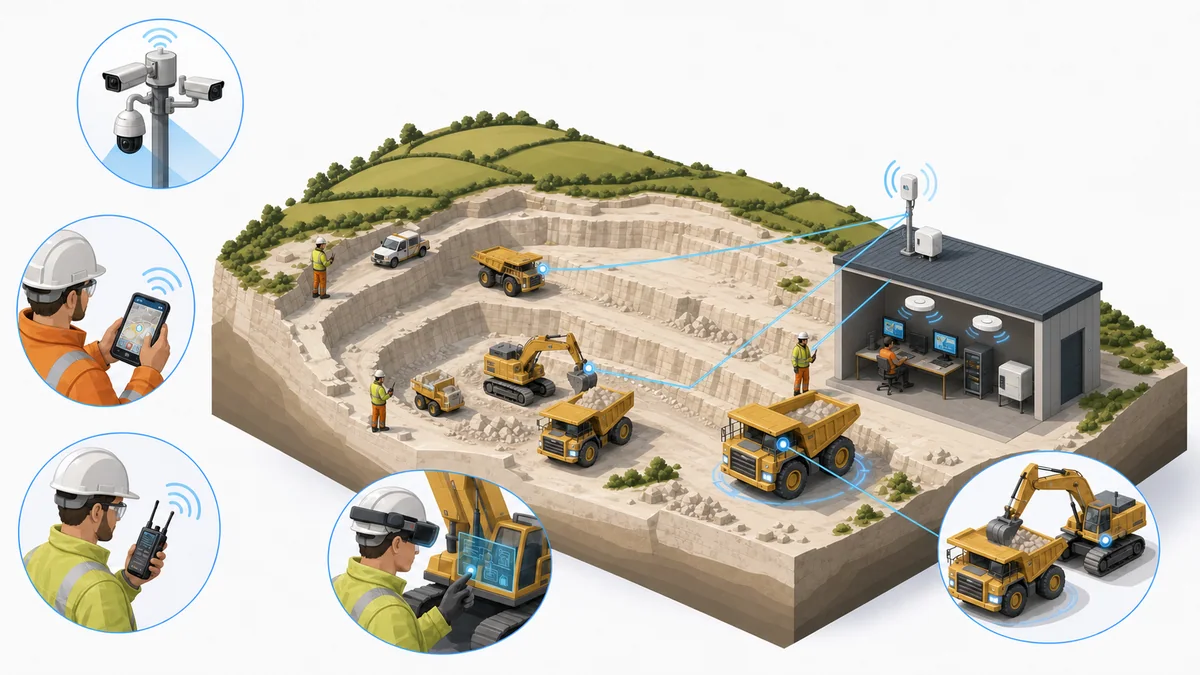
Private networks in mining
1.5 km
Private 5G reaches depths of up to 1.5 kilometres in a mining technology test environment, connecting equipment below the surface.
3.2 km
A private 4G LTE network connects underground teams and equipment with surface operations at a gold mine reaching 3.2 kilometres below ground.
10× fewer
A mining deployment covers the same area with ten times fewer private cellular nodes than its Wi-Fi comparison, reducing the number of network locations to manage.
A network that follows production
A mine is a changing workplace. Haul routes extend, extraction areas shift and equipment moves between the face, the crusher, the stockpile and the workshop. Underground, new headings and working levels add another dimension to the network.
Private 5G brings managed mobile connectivity to those working areas. It links vehicle terminals, cameras and industrial gateways to your applications, alongside existing fibre and Wi-Fi. The network becomes part of how the operation moves information throughout the shift.
Join up the information that production, maintenance and supervisors use every day.
Practical mining use cases
From the first load to the maintenance handover, connect the tasks that keep the site productive.
A haul-truck driver receives the next loading instruction on the cab display. At the face, the loading team records the material and destination; at the crusher or stockpile, the delivery completes the job in the dispatch system. Private 5G carries those updates along the haul route, linking the driver, loading equipment and control room as the work progresses.
When a crusher pauses or a queue builds, dispatch can send a revised instruction to the next available truck. Connect the fleet’s existing positioning and telemetry systems and supervisors can see vehicle status alongside the production plan. The result is a clearer picture of where loads are going and fewer radio exchanges to establish what has already happened.
A worker needs assistance at a remote working face. They raise an alert from a connected wearable or rugged handset, and the site’s safety application brings the event into the control room alongside their location from the tracking system. Private 5G carries the alert and supporting information, helping the supervisor establish who needs help, where they are and which team to contact.
The supervisor opens a voice link, shares the location with the response team and keeps the incident record updated as colleagues arrive. Connected environmental sensors can also feed readings into the same operational view, helping teams understand conditions around the working area. People, information and response activity come together to support the mine’s established health and safety procedures.
A supervisor starts a round with the current work list on a rugged tablet. At each working area, they review the task, attach photographs and update the handover for the surface team. A private cellular network distributed through the mine’s levels and tunnels carries those records back to the operational systems while the supervisor continues the round.
With suitable communications and tracking applications, teams can also share voice messages and location updates across working areas. The control room can see progress, coordinate the next task and bring another specialist into the conversation. Shift information becomes available as the work happens, rather than arriving as a collection of separate end-of-shift notes.
Automation and remote operation
Private cellular networks connect automated haulage, drilling and remote-operation systems with the people supervising them. They carry equipment telemetry, video and operational instructions between machines, local applications and the control room.
Private LTE connects autonomous haulage in an open-pit mining operation, with a development path to 5G.
For your site, the network is designed with the equipment and automation teams around the machinery’s response time, availability and safe-operation requirements. That creates a route from connected equipment today to the automation your operation needs next.
From the machine to the application
Design coverage around the terrain, haul routes and the movement of the working face. Radio positions, vehicle antennas, power and backhaul are planned together, with provision for extending the network as the site develops. Connect the operating areas that matter first, then extend into workshops, processing and stockpiles.
Underground coverage uses radio infrastructure within the mine, connected through its tunnels and levels. The layout follows the workings, power and backhaul routes, with equipment selected for the environment. Local core and computing infrastructure bring operational applications close to the work.
Planning & costs
We assess your estate, devices and applications, then design connectivity around the work you want to improve. We help build a business case around the opportunity, deployment costs and ongoing support.
We handle the technical assessment and help connect the investment to useful results. The first conversation starts with what you want to achieve.
Start with a focused deployment and expand, or move ahead with a full programme. We shape delivery around your priorities and readiness, and coordinate installation with your operation.
Talk to our teamPlanning questions
Yes. Radios and backhaul are installed within the workings to connect the required levels, tunnels and work areas. The design follows the mine’s layout and expansion plans; surface coverage and underground coverage are separate parts of the site network.
Yes. A quarry can start with a defined need such as haul-route connectivity, maintenance information or cameras at changing work areas. The project is sized around the operation and its applications, with a clear route to extend as requirements grow.
Compatible terminals and industrial gateways connect equipment to the private network. The design brings device bands, interfaces and application access together, so dispatch and maintenance information reaches the systems your team already uses.
The choice follows your devices, applications and growth plans. Private LTE is established in mining, while 5G adds options for newer devices and demanding workloads. We scope the network around the job, with the migration path considered from the start.
Coverage areas, terrain or tunnel layout, devices, radio infrastructure, power, backhaul and integrations shape the deployment. Bring a site plan and the first workflow you want to connect, and we can establish a practical scope for the project.
Read the private 5G cost guide →Connect your operation
Tell us about your site, equipment and the task you want to improve. We’ll help bring the network, devices and applications into a practical first project.
Website information and use cases provide general guidance. Performance, coverage, savings and suitability depend on site conditions, equipment, applications, integration and the agreed service scope. Illustrations and worked examples are indicative; third-party results relate to the original deployments.
Information may change or contain errors. Project-specific specifications, delivery commitments and commercial terms are set out in the agreed proposal and contract. External results relate to their original deployments; the fleet-time calculation illustrates the stated inputs.